KL, Selangor, Penang still lead wages, but new states are rising in 2026
New job opportunities are expected to expand in tandem with major investments in several states, making competition for high-skilled jobs more intense.



SHAH ALAM - As Malaysia enters 2026, the job market landscape and wage map are increasingly revealing the reality that not all states are moving at the same pace.
Sustained economic growth, the emergence of new technologies and the inflow of large-scale investments have shaped an increasingly competitive employment environment, where highly skilled workers have become the most valuable asset.
High value-added sectors such as professional services, finance, digital technology and advanced manufacturing are now the main drivers of economic growth, while demand for specialised skills continues to rise.
Market analysis by Bank Negara Malaysia (BNM) shows that new job opportunities are expected to expand in tandem with major investments in several states, making competition for high-skilled jobs more intense.
In this context, states that successfully align their workforce with industry needs will continue to attract talent and offer more competitive wages, while other states risk falling behind if they fail to develop suitable skills ecosystems.
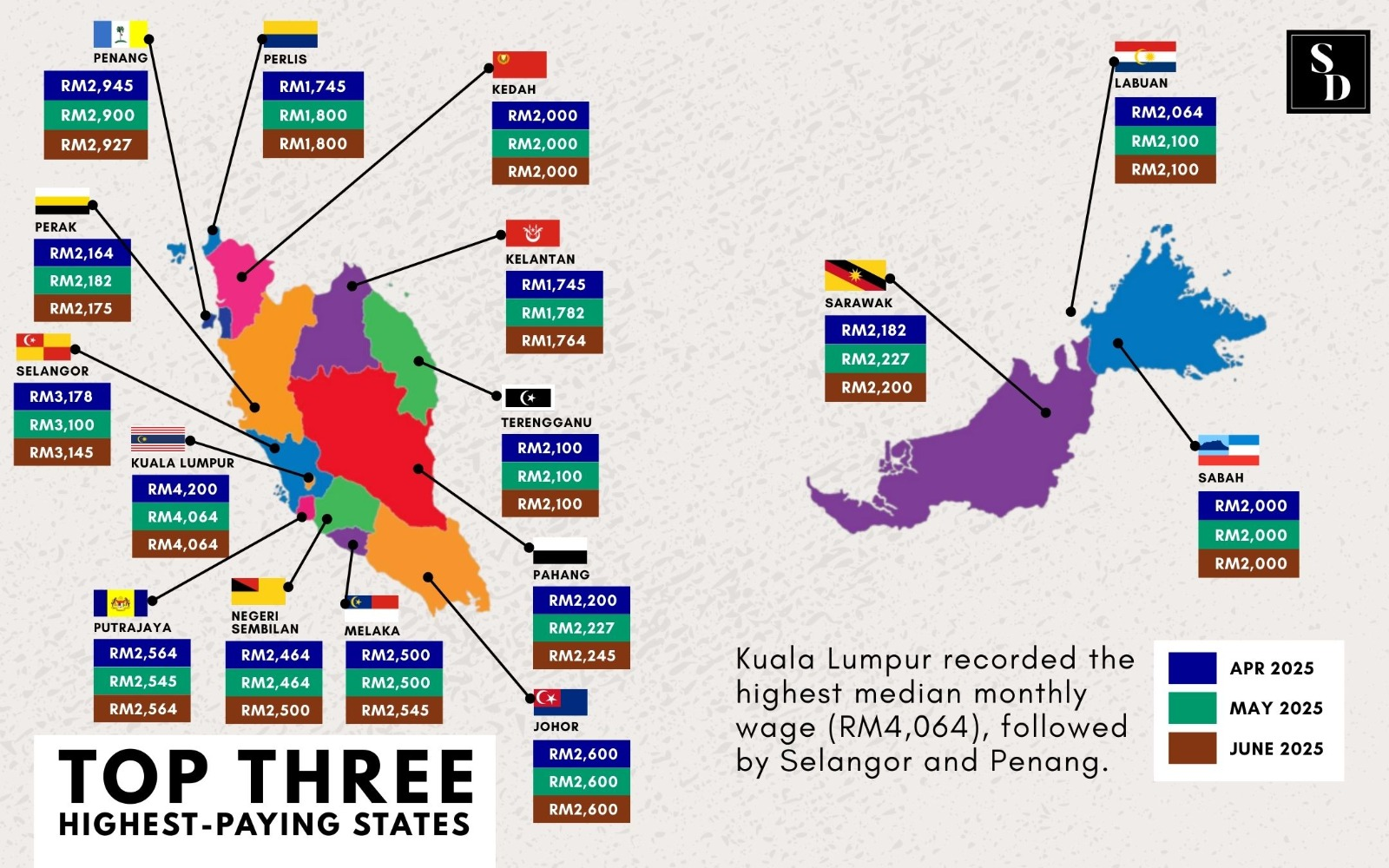
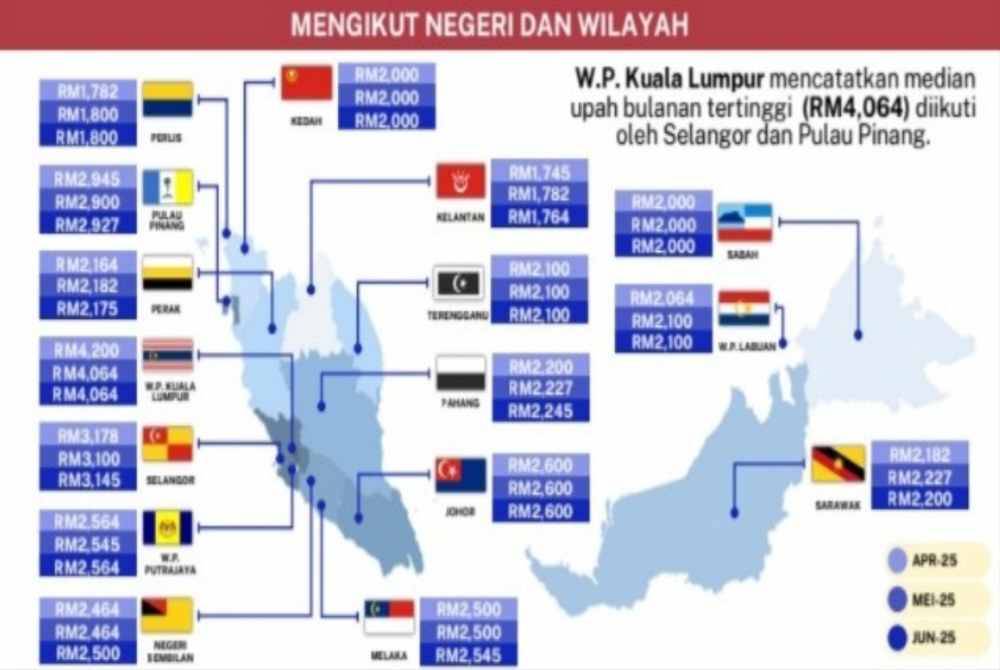
Meanwhile, official data from the Statistics Department (DOSM) shows that Kuala Lumpur, Selangor and Penang continue to record the highest median wages in the formal sector.
Kuala Lumpur recorded a median wage of RM4,064 per month, followed by Selangor (RM3,145) and Penang (RM2,927), well above the national median of RM2,864. The economic structure of these states, which is concentrated in high value-added sectors, is the main factor behind the wage gap.
However, job growth is no longer confined to the Klang Valley. Johor and Kedah are increasingly standing out due to major investments, while Sarawak is expected to see a significant boost in the energy and green economy sectors.
Future Studies Berhad Centre (The Future) economist Nur Azreen Mokhyi said wage levels are not determined solely by the number of job opportunities, but also by the quality and skills of the workforce.
“Wage differences between states are more influenced by economic structure and labour productivity, rather than location alone.
“States focused on professional services, technology and advanced industries typically offer higher wages. Workers with specialised skills and the flexibility to adapt to new technologies also have the potential to earn better pay.
“In addition, large companies and firms involved in global value chains are able to offer higher wages sustainably,” she told Sinar.

Azreen added that in 2026, the sectors driving wages and employment will differ by state, depending on their respective strengths.
Kuala Lumpur and Selangor, for instance, focus on professional services, finance and digital industries; Penang and Kedah on electrical and electronics (E&E), semiconductors, and automation; Johor on value-added manufacturing and logistics; while Sarawak concentrates on energy and the green economy.
All these sectors require a workforce that is highly skilled, flexible and productive.
At the same time, she said that reducing skills and opportunity imbalances between states requires aligning skills with industry needs, rather than merely increasing the number of graduates.
“TVET, short-term industry-based training, on-the-job training, and the recognition of non-formal skills are key mechanisms to enhance employability and career mobility.
“This approach allows workers in less developed areas to access quality jobs without having to go through long, conventional academic pathways.
“In addition, improving the productivity of local firms through technology adoption and process improvements also supports employers in offering higher wages,” she said.
Azreen said when productivity rises, wage increases can occur sustainably, making states more attractive without relying solely on large investments.
Conversely, states that are less successful in attracting investment need to build competitiveness through the development of a productive and relevant workforce.
Azreen also stressed that widening wage gaps will cause young and highly skilled workers to continue concentrating in only a few states, increasing pressure on the cost of living, housing, and public infrastructure in those areas.
In the long term, such imbalances could undermine national economic resilience and more inclusive growth.
Interestingly, Kedah and Sarawak have the potential to emerge as “dark horses” in 2026 — Kedah through investments in the E&E sector, and Sarawak by leveraging its strategic advantages in energy and the green economy.
“However, real success depends on how far investments are translated into quality jobs, skills upgrading, and productivity gains among the local workforce,” she said.
Azreen emphasised that states offering better jobs and wages in 2026 will be those that succeed in building ecosystems of skills, productivity and wage mobility, not merely those that attract large investments.
“The ability of the workforce to acquire, apply and upgrade skills, including through flexible learning and work experience, will be the key to better job opportunities and wages across the country,” she said.
Download Sinar Daily application.Click Here!