BN-PN seat-sharing deal may not guarantee vote transfers in Negeri Sembilan
The decision by Pas election director Datuk Seri Muhammad Sanusi Md Nor and Perlis PN chairman Datuk Seri Shahidan Kassim to stop using the term “UMDAP” suggested relations between BN and PN had entered a new phase.


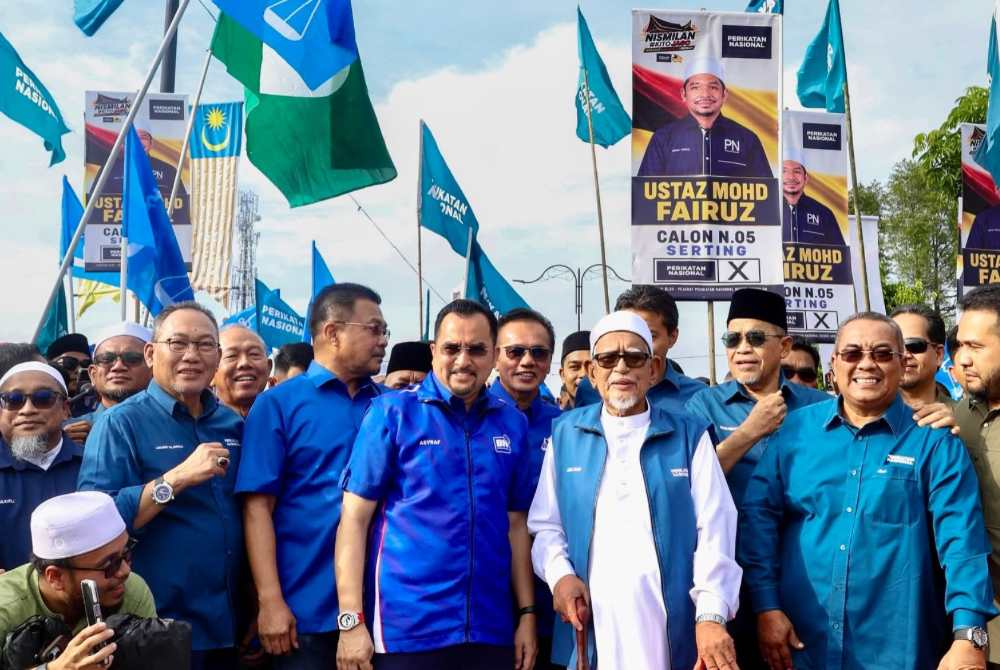
SHAH ALAM – Barisan Nasional (BN) and Perikatan Nasional’s (PN) seat-sharing arrangement for the Negeri Sembilan state election does not necessarily guarantee that supporters of both coalitions will transfer their votes to one another's candidates.
The decision by Pas election director Datuk Seri Muhammad Sanusi Md Nor and Perlis PN chairman Datuk Seri Shahidan Kassim to stop using the term “UMDAP” suggested relations between BN and PN had entered a new phase.
Umno secretary-general Datuk Dr Asyraf Wajdi Dusuki said Sanusi agreed to withdraw the term after he jokingly asked him to stop using it following the political understanding reached between BN and PN for the Negeri Sembilan state election.
He said both coalitions had not only avoided overlapping contests but were also working together to secure victories for each other's candidates across all 36 state constituencies.
However, the bigger question remained whether the understanding reached at the leadership level could truly translate into vote transfers at the grassroots.
On paper, the allocation of 25 seats to BN and 11 seats to PN accounted for all 36 state constituencies in Negeri Sembilan.
However, the formula alone did not guarantee that supporters of both coalitions would be willing to vote for candidates from their political partners.
Universiti Teknologi Mara (UiTM) senior political science lecturer Dr Ariff Aizuddin Azlan said this year's state election presented a very different political landscape from the 2023 state polls, which saw a contest between only two major blocs.
“If we look at the voting trend during the 2023 state election, the contest only involved two blocs, namely the unity government and PN. It was therefore relatively easy for voters to make their decision.
“This time, the contest will certainly reshape the political landscape because the state seats have been clearly divided between BN and PN. This will inevitably lead to vote transfers at the grassroots level,” he said.
Ariff said vote transfers were no longer merely theoretical, as the Johor state election had shown that such cooperation could be realised.
He said party loyalty remained a key factor, with supporters likely to vote for a coalition partner if their preferred party did not contest in a particular constituency.
“If their party does not field a candidate and it is replaced by a candidate from a coalition partner, that tendency remains unchanged and votes will be cast for that candidate,” he said.
He expected Klawang, Sikamat, Ampangan, Pilah, Labu and Paroi to be among the constituencies most likely to be affected by vote transfers.
However, Ariff said the success of the formula would ultimately depend on BN and PN's ability to manage the transfer of votes effectively.
Asked about simulations based on voting patterns from the 15th General Election (GE15) and the 2023 state election, which suggested Pakatan Harapan (PH) could lose its majority, while Negeri Sembilan PH chairman Datuk Seri Aminuddin Harun in Linggi and DAP secretary-general Anthony Loke in Chennah could also be at risk if BN-PN vote transfers were successful, Ariff said both candidate appeal and coalition strength would play equally important roles.
“During the Johor state election, PKR candidate Dr Maszlee Malik won in Puteri Wangsa despite Johor experiencing a blue wave. I believe he won because of his personal appeal as a candidate.
“However, in the Negeri Sembilan state election, if vote transfers are managed effectively by BN and PN, the candidate factor could become less significant. It should also be remembered that a high voter turnout does not guarantee victory for PH,” he said.
Non-Malay support expected to remain stable
Asked whether support among Chinese and Indian voters for PH could fall from around 95 per cent to 75 per cent, Ariff said he did not expect any significant shift in voting patterns among non-Malay voters.
Instead, he believed more noticeable changes were likely to occur among Malay voters.
“Even if there is some vote transfer, it is unlikely to be significant enough to cause parties such as DAP to lose their deposits. They may only retain seats with smaller majorities or lose one or two constituencies,” he said.
Ariff said the deciding factor remained the extent to which BN and PN could successfully combine their respective support bases.
“If we examine previous election data, PN has its own support structure, particularly through Pas. If that support is combined with BN's, it has the potential to create significant change and facilitate one-way vote transfers.
“At the same time, I do not see Bersatu's presence as a significant vote splitter because, within PN, the Pas brand appears to be more dominant,” he said.
Ultimately, while allocating 25 seats to BN and 11 seats to PN may have resolved negotiations at the leadership level, the real test will only come when supporters of both coalitions are prepared to transfer their votes to each other's candidates across all 36 state constituencies.
In other words, 25 plus 11 on paper does not necessarily equal 36 at the ballot box.
Download Sinar Daily application.Click Here!