Malaysia’s water crisis flows: Up to 85 per cent of NRW losses linked to ageing infrastructure - SPAN
Although the composition of NRW differs among water operators, Faizal said physical losses typically account for the largest share


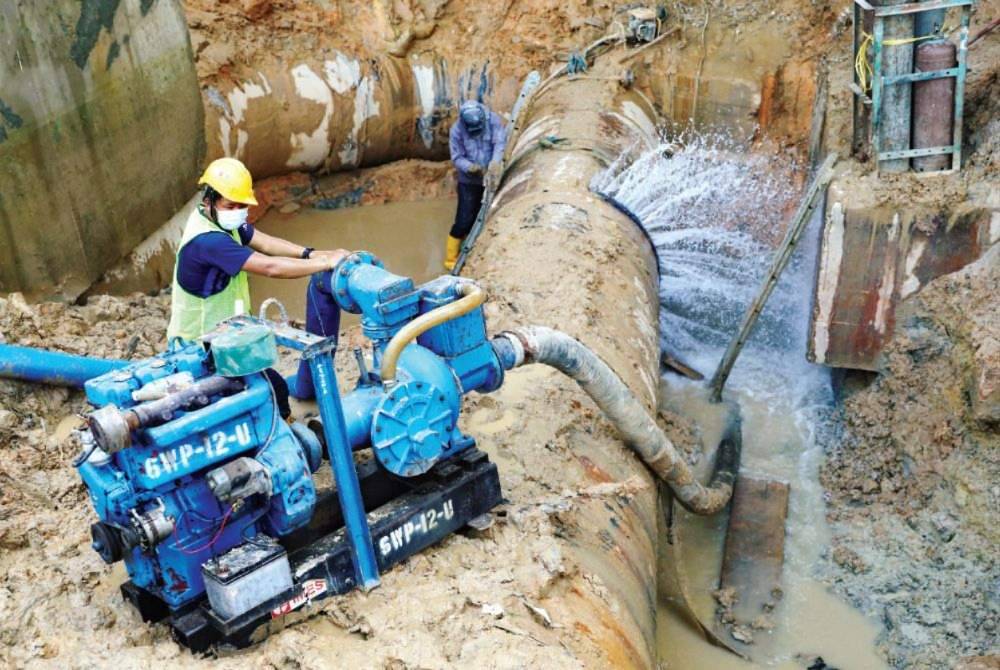
SHAH ALAM – Ageing infrastructure remains the biggest driver of Malaysia’s non-revenue water (NRW) crisis, with physical losses accounting for between 75 and 85 per cent of total water losses nationwide.
National Water Services Commission (SPAN) chief executive officer Datuk Ahmad Faizal Abdul Rahman said the majority of NRW stemmed from structural and asset-related issues, including ageing pipelines, leaks, pipe bursts, faulty service connections and reservoir overflows.
“This shows that the country’s NRW challenge is largely structural, driven by ageing pipelines, leakages, pipe bursts, service connection failures and reservoir overflows,” he told Sinar Daily.
NRW refers to treated water that enters the distribution system but does not generate revenue for water operators.
While physical losses account for the bulk of NRW, Faizal said commercial losses such as faulty meters, billing inaccuracies and illegal connections, as well as unbilled authorised consumption, also contribute to overall losses.
He said reducing NRW would require sustained investment in replacing ageing pipelines, strengthening leak detection capabilities, improving pressure management, accelerating repair works and enhancing asset management practices.
“Since 2020, SPAN has adopted the International Water Association (IWA) Water Balance Framework as the standard methodology for calculating, reporting and monitoring NRW in Peninsular Malaysia and Labuan.
“Under the framework, NRW is measured by comparing the total volume of treated water entering the distribution system with billed consumption. Losses are categorised into physical losses, commercial losses and unbilled authorised consumption,” he mentioned.

Faizal explained that NRW consists of three main components: physical losses, commercial losses and unbilled authorised consumption. Physical losses include pipeline leaks, pipe bursts, service connection failures and reservoir overflows.
Commercial losses stem from faulty meters, billing errors, illegal connections and inaccuracies in customer databases, while unbilled authorised consumption refers to legitimate operational uses such as firefighting, pipe flushing and emergency water supply.
Although the composition of NRW differs among water operators, Faizal said physical losses typically account for the largest share, making up about 75 to 85 per cent of NRW.
Commercial losses contribute around 15 to 20 per cent, while unbilled authorised consumption accounts for less than five per cent.
“Ageing pipelines remained a major concern because older pipes were more susceptible to leaks, bursts and joint failures, particularly in high-pressure areas or locations with poor ground conditions and heavy traffic.
“However, pipe age alone should not determine replacement priorities, as some older pipelines continue to perform effectively while newer ones can fail because of poor installation, unsuitable materials, pressure fluctuations or ground movement,” Faizal mentioned.
Although SPAN does not directly undertake replacement works, it advises state water operators on priorities based on NRW levels, recurring bursts and leaks, repair costs, service disruptions, customer complaints, pipe material and overall asset condition.
Among the sector’s biggest challenges is the replacement of asbestos cement (AC) pipelines, with an estimated 39,000km requiring eventual replacement nationwide.
“The replacement process must be carried out through a phased long-term programme, with investments focused on areas that can deliver the greatest reductions in NRW and improvements in service reliability,” he said.
The issue has drawn increasing concern from water sector experts, who recently told Sinar Daily that Malaysia’s NRW problem has evolved into a broader water security challenge.
Former SPAN chairman Charles Santiago said about 35 per cent of treated water was being lost before reaching consumers, largely because of ageing infrastructure, particularly AC pipelines.
He has called for stronger financing mechanisms, greater political commitment and long-term planning to address the scale of deterioration.
Meanwhile, Universiti Putra Malaysia water engineering expert Associate Professor Dr Syazwani Idrus said solving the NRW problem would require both infrastructure upgrades and the adoption of technologies such as smart meters, acoustic leak detection systems, pressure management tools and predictive analytics to improve efficiency and reduce losses.
Download Sinar Daily application.Click Here!