Tok Min prioritises performance over sentiment
The Negeri Sembilan PH chairman said the coalition has many Malay figures from corporate, religious, professional and administrative backgrounds who are capable of being appointed as Menteri Besar.


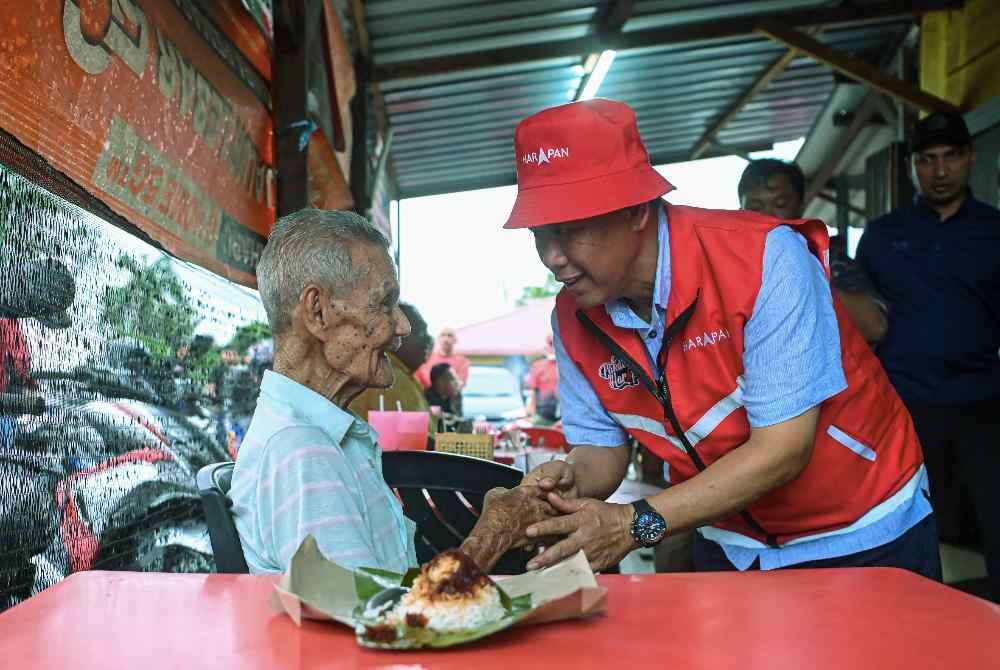
PORT DICKSON – Negeri Sembilan caretaker Menteri Besar Datuk Seri Aminuddin Harun has stressed that Pakatan Harapan (PH) still has qualified candidates capable of leading the state government should the coalition win the Negeri Sembilan state election, even if he loses the Linggi State Legislative Assembly seat.
The Negeri Sembilan PH chairman said the coalition has many Malay figures from corporate, religious, professional and administrative backgrounds who are capable of being appointed as Menteri Besar.
He added that he would accept whoever is chosen by the party leadership if he is unable to continue holding the position after the state election.
However, Aminuddin stressed that he remains PH’s Menteri Besar candidate for now and has received the agreement of all coalition candidates to continue leading the state if given the mandate by the people.
In an exclusive interview with Sinar, he also admitted that his decision to leave the safe seat of Sikamat to contest in Linggi, a traditional Barisan Nasional (BN) stronghold, was a major political gamble.
However, he described the move as a sacrifice by a leader willing to step out of his comfort zone to help PH increase its number of seats and defend the Negeri Sembilan administration.
The following is the exclusive interview between Aminuddin and Sinar reporters Farah Shazwani Ali, Haizir Othman and Syamilah Zulkifli, together with videographer Yusrizal Yusuf Ahmad, in Port Dickson, Negeri Sembilan, recently.
SINAR:
During the 15th General Election (GE15), Datuk Seri Anwar Ibrahim contested the Tambun parliamentary seat, which was not a Pakatan Harapan (PH) seat, but the move eventually paid off. Is your decision to contest the Linggi state seat, which is also a BN stronghold, based on a similar risk or strategy? 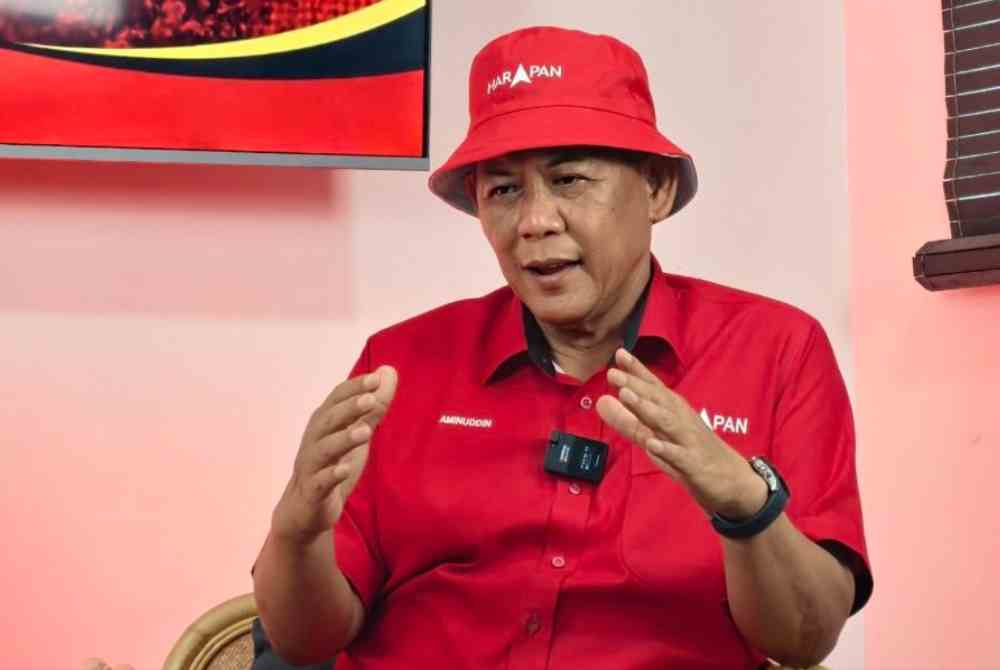
DATUK SERI AMINUDDIN HARUN:
That may have been an idea that came to me at the time. I also looked at the bigger picture — how many seats PH needs to win this time.
That was among the considerations I had to make because it sends a clear message that as a leader, we cannot simply remain in a comfortable position.
If Anwar was willing to step out of his comfort zone, why should we not do the same for Negeri Sembilan this time?
I believe sacrifices have to be made to ensure we can increase the number of seats we win this time. It carries a significant risk if Anwar fails to win the Linggi seat. Will you regret making that decision?
I have thought about it carefully. Many friends themselves asked me to reconsider the proposal, but I decided to proceed.
I brought it to the Political Bureau and they also questioned why I made such a decision because, for them, the area is not an easy one to win.
However, we have to look at it from the perspective that when we want change, we have to work towards victory. That is the objective.
When contesting in an election, we need victory. That is why I have conveyed my intention to the people of Linggi and explained what I intend to do for the constituency in the future.
This is what I have to prove moving forward — that we want to work to ensure Linggi changes, InsyaAllah.
SINAR:
Does your position as Menteri Besar and Port Dickson MP provide an advantage?
DATUK SERI AMINUDDIN HARUN:
I do not deny that it does.
However, I also have to consider the strength of the existing candidate because we may be evenly matched. This is among the important factors during the campaign — what we want to implement.
Although I am currently the Menteri Besar, if I am able to become Menteri Besar again in the future, it would be something better for the people of Linggi. I am fully aware that the decision I made carries a major risk.
SINAR:
If PH succeeds in forming the state government but Datuk Seri loses in Linggi, who will be appointed as Menteri Besar?
DATUK SERI AMINUDDIN HARUN:
I have a very capable team. PH has many qualified Malay candidates from various backgrounds, including corporate figures, religious figures, professionals and those involved in administration, who can be appointed as Menteri Besar.
Even if I am not there, they can be appointed. We are not worried because I believe the decision will be made by the leadership and everyone will accept it.
I will also accept whoever is chosen. However, for now, the party leadership has announced me as the Menteri Besar candidate and I am prepared to continue carrying out the responsibility if PH continues to receive the mandate from the people.
Today, all candidates contesting have agreed that I should become Menteri Besar. Therefore, this matter is not an issue.
We also do not want the selection of the Menteri Besar to become the cause of a crisis or division within the state administration when the time comes.
SINAR:
Perhaps residents of Linggi have become comfortable and familiar with the presence of Datuk Mohd Faizal Ramli as their assemblyman. What differentiates you from the incumbent?
DATUK SERI AMINUDDIN HARUN:
When I went down to Linggi, I saw that they need major changes, especially in terms of the economy and significant development in the area so that it can become a game changer. I acknowledge this.
Alhamdulillah, I have brought to Linggi plans for an artificial intelligence (AI)-based Smart Port and an industrial area that we previously never imagined. I believe that if these are the priorities of the people in Linggi, they will give their support and change the lives of a large part of the community here, InsyaAllah.
SINAR:
We saw the momentum from the Johor state election when BN secured a major victory. Do you see that as a concern or is Negeri Sembilan different?
DATUK SERI AMINUDDIN HARUN:
I have never said I am not worried. The Johor results were very concerning to me.
At the time, together with my friends and party leadership, we looked at the situation in Negeri Sembilan and asked: what will happen? What will the situation be like during the campaign?
If they followed the approach used in Johor, it would make our campaign more difficult. However, today we can see that the people of Negeri Sembilan are different.
They are different because they want to see the report card become a priority among the people of Negeri Sembilan. They are not playing with racial sentiments, excessive religious sentiments, or campaigns accusing certain parties, for example DAP.
Their priority is the report card, or the work that PH has carried out. This is among the key focuses of our campaign so that they can evaluate.
Not everyone is able to evaluate, but a large portion, especially young voters and middle-aged voters, are looking at this. This is important because they are struggling with their daily lives.
They need to know how a government that is elected later can help ease the cost of living, provide employment opportunities, increase income, create business opportunities and ultimately provide welfare for the people.
They are not merely bound, restricted or influenced by excessive party-based campaigns, racial issues and so on.
SINAR:
Do you feel that after two terms, PH has done enough to gain the support of Malay voters who may previously have been unfamiliar with PH, which includes DAP?
DATUK SERI AMINUDDIN HARUN:
I do not deny that there are concerns. However, at the same time, when we go down to campaign, we look at fence-sitters and those who do not support any particular party.
They are not members of PKR, DAP, Amanah, Umno, Bersatu, Pas or any other party. They sit back and observe what is happening to us and our state.
They are the group that plays a major role in determining the victory of any party. How we convince these fence-sitters is important so that their assessment of us becomes more positive.
That is what parties should do. If we look around the world, it is the same.
Their numbers may be small. For example, smaller parties can control a country or a state because they gain confidence from this group — people who remain quiet, who are not involved in party programmes, but who have great power in determining the direction of a state and country in the future.
SINAR:
Political culture in Malaysia today is strongly shaped by who people support and who they oppose. Has Negeri Sembilan reached a stage where political identity is no longer the main priority or barrier?
DATUK SERI AMINUDDIN HARUN:
I remain optimistic that throughout these two terms, or eight years of this administration, we have never asked them what party they belong to when they come to seek assistance.
We do not choose who receives help.
If we look at the previous election, although we were together with BN, and although the transfer of votes to PH and DAP was small, we were still able to retain 17 seats.
This is very important for all of us. For me, fence-sitters are our most important priority.
SINAR:
How do you break the major barrier that political identity should no longer matter and that voters should instead focus on performance?
DATUK SERI AMINUDDIN HARUN:
The concern still exists, but we must remember that Negeri Sembilan is unique because a large portion of its voters are based in Selangor, Kuala Lumpur and outside Negeri Sembilan. I refer to them as the middle-class group and young people, including those who are studying.
Their numbers are large, while those who remain here locally are mostly retirees. This group is actually more influenced by local politics.
Therefore, we want those outside the state to know what is happening in Negeri Sembilan. That is why we present the report card.
This is not only for those living in Negeri Sembilan, but also for those outside the state. They also want to know what assistance their parents received, what programmes benefited their families, their villages, their religion and their community.
In certain areas, almost 40 per cent of voters are outside the state. Some have 30 per cent, some have 20 per cent.
These numbers are significant. That is why I said earlier, this group does not belong to any party.
Let us face this election with the understanding that what matters is how we work for the people, not building sentiments of hatred that eventually cause harm. We cannot fight emotions with emotions. We have to look at what needs to be done.
SINAR:
During the two years and eight months of PH and BN administration in Negeri Sembilan, an unexpected incident eventually occurred. Did the cooperation itself become shaky at the early stage?
DATUK SERI AMINUDDIN HARUN:
We came together to strengthen the administration and discussions had already started before the election. We worked together at the federal and state levels.
We were instructed to become a unity government state. We accepted this when the Pakatan Harapan chairman (Anwar) and BN chairman (Datuk Seri Ahmad Zahid Hamidi) wanted the unity government to be established in Negeri Sembilan.
They also requested that Lenggeng and several other areas be handed over, although we knew we could win those areas in the previous election. However, they said those areas had previously been contested by BN, so they should be returned.
That was not a problem because we upheld the spirit of unity. Eventually, we contested the election, with PH winning 17 seats and BN winning 14 seats, under the slogan: “Work together, win together.”
After winning, we organised and discussed matters so that village chief positions were divided equally and councillor positions were also divided equally. Everything proceeded well without any problems.
I had senior executive councillors, including executive councillors from Umno and we worked well together. They also worked alongside DAP executive councillors in carrying out their duties. There were no racial issues at that time.
That is why I said this state has been educated in the spirit of unity, not racial politics. However, when elections arrive, racial issues are brought up and that is wrong.
These discussions also took into account the possibility that the general election could be held earlier. During an Executive Council meeting, it was said that our friends hoped the state government could last until the end of the term and that we would face the election together.
However, that did not happen. When they came to my house the night before the State Legislative Assembly meeting, there was a meeting between me and four Umno executive councillors.
After meeting, they expressed their support for me. They said they had no problem working with me and that it was even easier compared to working with the previous Menteri Besar who was led by their party.
This good relationship, I thought, would continue. I stated that night that we would postpone the sitting after the opening ceremony of the State Legislative Assembly session.
They also agreed. Although initially there were calls for it to be cancelled, we made the decision together.
Eventually, we agreed to postpone the sitting. But after four days, they held a press conference announcing that they were withdrawing their support for me without stating the main reason and without any discussion.
For me, what came as a surprise was that when they announced their withdrawal of support, I discovered that they had already held earlier discussions with the opposition — two from Bersatu and three from Pas.
This showed that they wanted power.
Whether we call it “roof hacking” or “ship hacking”, this was what happened. When this occurred, it was not in line with the wishes of the federal government.
The federal government was still a unity government.
At the same time, they could withdraw support and cooperate with the opposition. This was something the people of Negeri Sembilan clearly saw and understood.
The issue was not about the palace or traditional institutions. For me, what actually happened was an issue of power.
SINAR:
Was this a painful lesson to face, but ultimately useful in determining future political partners?
DATUK SERI AMINUDDIN HARUN:
This is something we are considering now. When it happened in Johor, the State Legislative Assembly was dissolved.
The same happened in Negeri Sembilan. This is part of the political journey.
However, I believe I must respect the decisions of the top leadership. I have my own leadership.
We have the Political Bureau that will discuss decisions. We have the PH Presidential Council to discuss matters.
It requires time and proper planning. These are among the things that people should see — how dynamic politics is today.
Politics at the federal level and state level can be different.
SINAR:
In one statement, Datuk Seri mentioned that PH is increasingly accepted. Is this realistic to achieve now, when emotions and sentiments are increasingly being used strongly by opponents?
DATUK SERI AMINUDDIN HARUN:
As I said earlier, there are not many politicians, or people who actively follow political parties. Even among party members, there are different types.
Some only fill in membership forms and remain quiet. Some actively follow politics, attend ceramahs every night and fill halls.
Some politicians remain quiet in their villages and engage with their neighbours. So actually, a large portion of our political members and voters are outside this environment.
They are busy with their work, their lives, the pressures they face and everything else. Those who do not have the opportunity to participate in politics are actually the larger group.
We often assume that this group will simply follow the majority. But in reality, they know their responsibilities.
They know how to evaluate and make choices. Many of them want to reveal their decision only at the polling station.
In the current situation, the only way to judge whether we can win or not is at the polling station.
They remain quiet. They do not speak. They do not show support for anyone at this moment.
But actually, they have already made their decision. This is one of the unique things about every election when the year changes.
"DAP is not PH’s only strength"
The people of Negeri Sembilan should support Malay candidates from PH in the state polls to strengthen the position of Malays in the state government, Aminuddin said.
He said DAP was only allocated 11 out of the 36 state seats, while the remaining candidates consisted of religious figures, professionals, doctors, corporate figures and individuals with administrative experience.
“We only placed DAP in 11 seats to ensure the strength of Malays within PH,” he said.
According to Aminuddin, there is no basis to claim that PH’s strength depends solely on DAP because the coalition has qualified candidates from various backgrounds.
He added that cooperation with DAP throughout the previous two terms had also proceeded well without pressure.
`
Download Sinar Daily application.Click Here!