How FIFA’s World Cup investment plan triggered global backlash
Here's how the controversy unfolded.


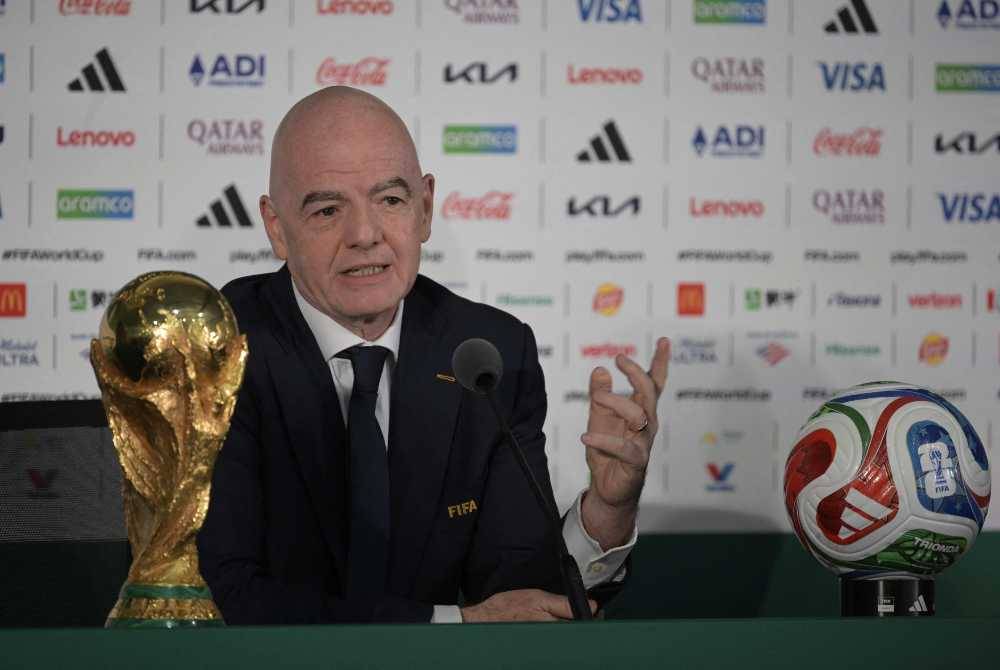
SHAH ALAM - FIFA’s proposal to create a US$20 billion commercial subsidiary to manage the business operations of its flagship competitions, including the World Cup, has ignited one of the biggest governance disputes in world football.
While FIFA president Gianni Infantino described the plan as an opportunity to increase funding for the sport’s 211 member associations, UEFA and several football bodies warned that allowing private investors into FIFA’s commercial structure could threaten the independence and identity of the game.
Here is how the controversy unfolded.
What is FIFA’s proposed investment plan?
The proposal centres on the creation of FIFA Forward Enterprise (FFE), a separate commercial entity that would combine FIFA’s revenue-generating activities, including broadcast rights, sponsorships, ticketing, licensing and event operations.
FIFA estimates the new subsidiary could be valued at around US$20 billion, with the organisation planning to sell up to 20 per cent minority stakes to external investors while retaining majority ownership and control.
FIFA said it hopes to raise about US$4.2 billion (RM17.2 billion) through carefully selected long-term investors. The additional revenue would then be channelled into football development programmes worldwide.
Under the proposal, each of FIFA’s 211 member associations could receive up to US$40 million for the 2027–2030 cycle — consisting of a US$20 million one-off “Fast-Forward” payment and US$20 million through the FIFA Forward development programme.
Future cycles could see funding rise to US$22 million for 2031–2034 and US$24 million for 2035–2038.
Tuesday the proposal becomes public
FIFA announced plans to establish FIFA Forward Enterprise, sparking immediate criticism from football organisations that claimed they had not been properly consulted.
The organisation insisted the new structure would not affect football governance, competitions or regulatory decisions.
FIFA said it would maintain exclusive control over sporting matters and retain majority ownership of the subsidiary.
The plan also required approval through a democratic process involving FIFA’s 211 member associations and the FIFA Council.
Infantino defends the plan as a “Golden Opportunity”
Following criticism, Infantino defended the proposal, arguing that the plan would unlock commercial value that could benefit football globally.
In a video statement, Infantino described the proposal as an option rather than a compulsory decision.
“FFE is actually a proposal, an offer. It is part of a democratic process, a consultation process and above all, it is an opportunity but not an obligation. It is a golden opportunity to turbocharge the development of the game globally. But again, it is just an offer, not an obligation.
“Capturing that value requires additional expertise, additional insight, distinct from governing and developing the sport.
“Fans from everywhere in the world would gain immeasurably from this game-changing potential because it will transform football in their countries,” he said.
Sept 19: Deadline for member associations
According to reports, FIFA member associations were informed that they would need to support the plan by Sept 19, to qualify for the one-off Fast-Forward funding.
A letter from Infantino to member associations reportedly stated that backing the proposal would unlock a US$10 billion package from Jan 1, 2027.
“Should you wish to proceed, this US$10 billion package will become available as of Jan 1, 2027, ushering in the next phase of our journey together.
“In exchange, all that is required is your continued trust, everything else remains the same,” Infantino said.
Critics argued that the deadline placed pressure on national associations to accept the proposal.
UEFA leads opposition against FIFA
UEFA became the strongest opponent of the plan, warning that private ownership of football competitions would cross a line that should not be breached.
The European football governing body said the World Cup should not become a financial asset controlled by investors.
“The soul and governance of football are not assets to trade, especially with zero transparency as to who gains financially. None of us are the owners of football. It is not FIFA’s to sell.
“No UEFA national teams will participate in any FIFA competition for so long as these proposals remain alive.
“Unless this proposal has been abandoned in its entirety and binding assurances have been given that FIFA will never again open its governance or competitions to private ownership.”
“The World Cup cannot be treated as an investment product. No part of it should ever be surrendered to private investors. The World Cup is not for sale,” UEFA emphasised.
UEFA president Aleksander Ceferin stressed that football should not be shaped by investors focused solely on financial returns.
He said Europe’s stance is clear, rejecting any model that seeks to commercialise the sport in a way that undermines its principles, arguing that no one has the moral authority to sell something they merely hold in trust for future generations.
Global football bodies raise concerns
Opposition to the proposal spread beyond Europe.
The Confederation of North, Central America and Caribbean Association Football (CONCACAF) criticised the lack of consultation before the plan was made public.
“The membership expressed deep concerns about the lack of due process surrounding the proposal, the artificially short deadline imposed and the absence of any review or approval by the relevant FIFA governance bodies,” it said.
The Asian Football Confederation (AFC) also expressed disappointment that member organisations were not consulted earlier.
The Confederation of African Football (CAF) encouraged its members to carefully examine the proposal before making decisions.
The European Union also voiced opposition, with EU commissioner for sport Glenn Micallef saying: “Hands off our game.”
Previous concerns over FIFA commercial expansion
The controversy revived earlier debates over FIFA’s approach to commercial expansion.
In 2019, a FIFA stakeholders’ committee rejected an Infantino-backed proposal for a US$25 billion private investment involving an expanded Club World Cup. Reported potential investors included Japan’s SoftBank and Saudi Arabia’s sovereign wealth fund.
FIFA later expanded the Club World Cup from seven teams to 32 clubs in 2025.
Former FIFA president warns football could lose its identity
Former FIFA president Sepp Blatter criticised the proposed structure, arguing that football should not become a profit-driven corporation.
“Football belongs to no individual and to no institution. It belongs to the people. If FIFA was transferred into a profit-oriented corporate structure, it would lose its soul,” he said.
The bigger debate over football’s future
At the centre of the dispute is a fundamental question — should football’s biggest competitions remain controlled solely by sporting institutions or should outside investment play a larger role in expanding the game?
FIFA argues that private investment would generate more resources for global football development, particularly benefiting smaller associations.
However, critics fear that commercial interests could influence decision-making and weaken football’s traditional governance model.
As UEFA stated:
“Some things are simply too important to sell. The FIFA World Cup belongs to football. It always will. And so long as Europe has a voice, it will never be for sale.”
Download Sinar Daily application.Click Here!