Malaysia sees declining child population
The demographic shift also saw 12 states attain ageing-state status.


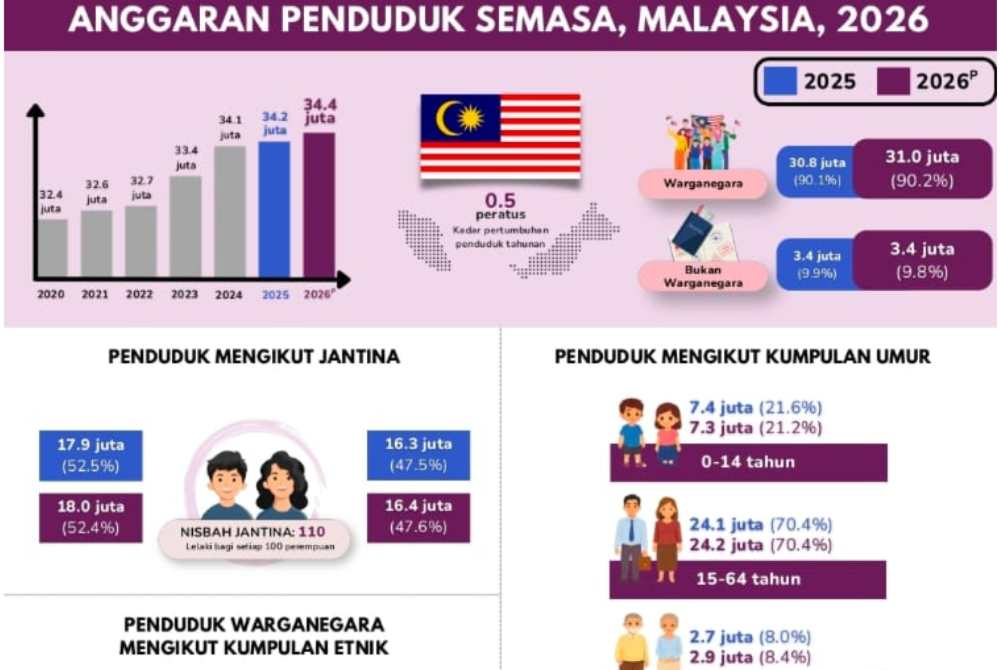
PUTRAJAYA - Malaysia's child population continued to decline, with the proportion of residents aged between 0 and 14 falling to 21.2 per cent in 2026 from 21.6 per cent a year earlier.
Chief Statistician Datuk Seri Dr Siti Asiah Ahmad said the proportion of the population aged 15 to 64, or the working-age group, remained unchanged at 70.4 per cent over the same period.
She said the proportion of residents aged 65 and above increased from 8.0 per cent in 2025 to 8.4 per cent this year.
“The proportion of the population aged 0 to 14 years (young age group) declined from 21.6 per cent in 2025 to 21.2 per cent this year, while the proportion of those aged 15 to 64 years (working-age group) remained at 70.4 per cent compared with 2025.
“During the same period, the proportion of the population aged 65 years and above (older age group) increased from 8.0 per cent to 8.4 per cent,” she said in a media statement on the Current Population Estimates, Malaysia, 2026 released by the Statistics Department (DOSM) on Friday.
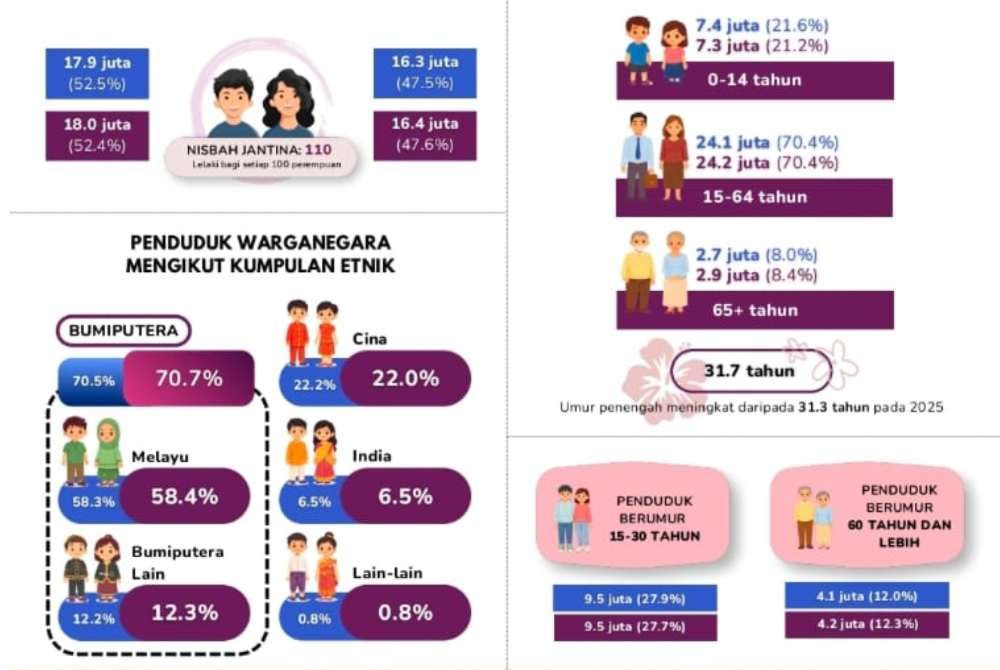
She said the demographic shift also saw 12 states attain ageing-state status, defined as states where residents aged 65 and above account for more than seven per cent of the total population.
According to Siti Asiah, Perak continued to record the highest proportion of elderly residents at 10.8 per cent, while Malaysia’s median age rose to 31.7 years from 31.3 years the previous year.
In the same statement, Siti Asiah said Malaysia’s population was estimated to have increased to 34.4 million in 2026 from 34.2 million in 2025, with the population growth rate remaining at 0.5 per cent.
She said the citizen population increased from 30.8 million to 31.0 million, while the non-citizen population continued to record a negative growth rate of -0.2 per cent.
“Selangor continued to record the largest share of the population in 2026 at 21.7 per cent, followed by Johor (12.3 per cent) and Sabah (11.0 per cent),” she said.
Meanwhile, the Federal Territories of Labuan and Putrajaya recorded the smallest population shares at 0.3 per cent and 0.4 per cent, respectively.
The Current Population Estimates, Malaysia, 2026 report was published by DOSM based on the 2020 Population and Housing Census using the cohort-component method, which takes into account births, deaths and migration. The report presents population estimates for 2025 and 2026.
At the state level, Terengganu recorded the highest population growth rate at 1.2 per cent, followed by Kelantan (1.0 per cent), Selangor (0.6 per cent), the Federal Territory of Putrajaya (0.6 per cent) and Pahang (0.6 per cent).
In terms of age composition by state, the Federal Territory of Putrajaya recorded the highest proportion of residents aged 0 to 14 at 31.4 per cent, while the Federal Territory of Kuala Lumpur recorded the highest proportion of working-age residents at 76.0 per cent.
Malaysia also recorded an overall dependency ratio of 42.0 in 2026, compared with 42.1 the previous year, driven by a decline in the youth dependency ratio, while the old-age dependency ratio continued to rise.
Download Sinar Daily application.Click Here!