Who was Chin Fung Kee? Penang's new road name has people asking
Persiaran Pantai Sinaran, an 800-metre road within The Light City development, was renamed Persiaran Chin Fung Kee following approval by the Penang government on Feb 25.
HAJAR NAZLI
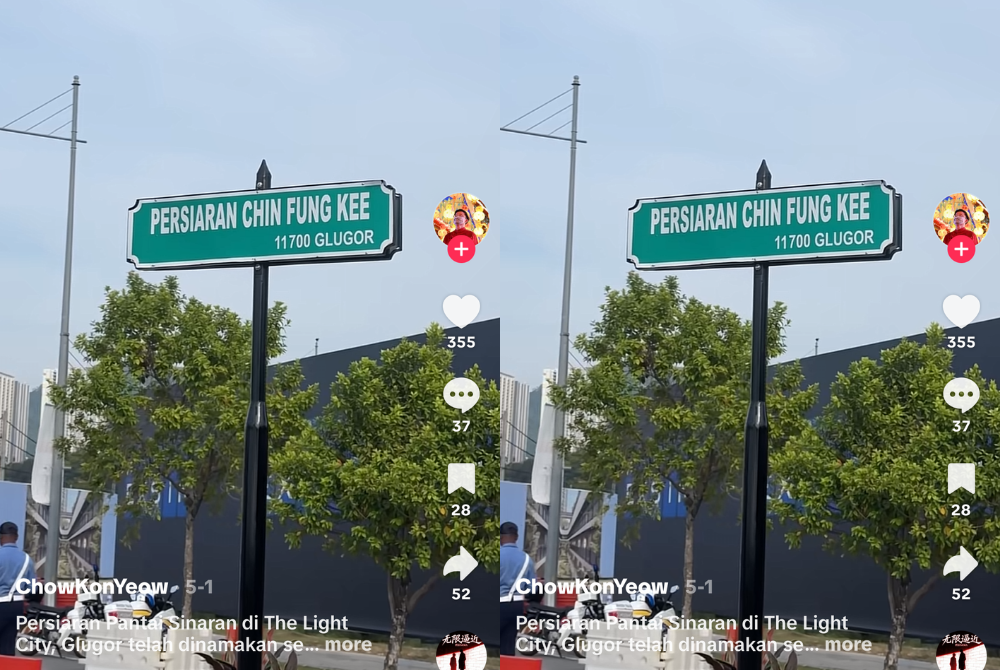
THE recent renaming of a stretch of road in Gelugor has left many residents scratching their heads: who is Tan Sri Professor Dr Chin Fung Kee?
The answer, it turns out, is a man whose fingerprints are on two of Penang's most recognisable landmarks - the Penang Bridge and Komtar - even if his name never made it onto either.
Persiaran Pantai Sinaran, an 800-metre road within The Light City development, was renamed Persiaran Chin Fung Kee following approval by the Penang government on Feb 25.
Chief Minister Chow Kon Yeow officiated the ceremony and the choice of location was no accident - the road sits close to the Penang Bridge, one of the projects that made Chin's name in the first place.
Penang Infrastructure, Transport and Digital Committee chairman Zairil Khir Johari said the renaming came after a formal application by the Institution of Engineers, Malaysia (IEM), which pushed for Chin's contributions to be formally recognised.
The bridge builder
Chin served as project director for the planning, design and construction of the Penang Bridge. His most lasting technical legacy there was an innovative seismic resistance system using natural rubber bearings - a cost-effective way to protect the bridge from earthquakes that also opened up new industrial applications for Malaysia's natural rubber sector.
The man who saved Komtar
Fewer people know that Chin also quietly rescued one of Penang's most ambitious construction projects from disaster.
In the late 1970s, as the 65-storey Kompleks Tun Abdul Razak - better known as Komtar - rose over George Town, engineers noticed something alarming: the tower was settling unevenly, a consequence of Penang's soft and variable marine clay.
Differential settlement of that kind can compromise a structure's integrity and for a building of Komtar's scale, the stakes were high.
Chin, already one of Malaysia's foremost geotechnical engineers, was brought in to lead the foundation rectification works. His intervention stabilised the structure and allowed construction to continue.
A method that outlived the man
Beyond individual projects, Chin's influence spread through the "Chin Method", an analytical technique for predicting the ultimate load-bearing capacity of foundation piles without testing them to destruction. It saved engineers time and money on pile-load testing and remains associated with his name in geotechnical circles today.
From Nibong Tebal to the world stage
Chin was born in Nibong Tebal in 1920 and studied at High School Bukit Mertajam before earning a First-Class Diploma in Arts from Raffles College in Singapore. He won the Queen's Scholarship in 1949 to study civil engineering at Queen's University Belfast, where he later completed his master's degree.
Returning to Malaya in 1955, Chin moved into academia, rising from lecturer to professor at the University of Malaya in Singapore. When the university expanded to Kuala Lumpur in 1958, he helped establish its Faculty of Engineering, later serving as acting vice-chancellor before retiring as Emeritus Professor in 1973.
His honours included the National Science Award in 1988, and he served as president of both IEM and the Southeast Asian Geotechnical Society. Chin died on Aug 29, 1990.
Why it matters now
Before the renaming, Persiaran Pantai Sinaran was simply a descriptive name for a central road linking the residential, commercial, retail and convention facilities of The Light City's reclamation development.
The state government said swapping it for Persiaran Chin Fung Kee was a deliberate move to preserve the legacy of one of Penang's most influential engineering pioneers - someone whose work locals have long driven over and stood beside without knowing his name.
Download Sinar Daily application.Click Here!