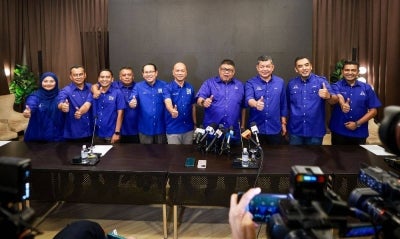
BN has potential to become a dominant force in GE16
This development follows BN's growing political momentum after the Johor and Negeri Sembilan state elections, alongside statements by PKR president Datuk Seri Anwar Ibrahim expressing his intent to continue cooperation with BN at the federal level.



PUTRAJAYA – Barisan Nasional (BN) is increasingly strengthening its position as a strategic political force or 'kingmaker', as the coalition is now seen to have choices in determining the direction of its political partnerships ahead of the 16th General Election (GE16).
This development follows BN's growing political momentum after the Johor and Negeri Sembilan state elections, alongside statements by PKR president Datuk Seri Anwar Ibrahim expressing his intent to continue cooperation with BN at the federal level.
Political analyst Professor Datuk Dr Sivamurugan Pandian said Anwar's statement demonstrates that BN still holds immense strategic value and is not merely an ordinary partner in the unity government.
“Yes. I view Anwar’s statement as an acknowledgement that BN still retains high strategic value, rather than being just a regular partner in the unity government.
“Anwar emphasised that he chooses stability and wishes for cooperation with Umno-BN to continue at the Federal level, while acknowledging his good relationship with BN chairman Datuk Seri Dr Ahmad Zahid Hamidi,” he told Sinar.
Sivamurugan explained that BN’s current standing leans more towards being a ‘kingmaker’ that is rebuilding its strength to return as a dominant force in the nation's political landscape.
He noted that BN’s solid performance in Johor and Negeri Sembilan showed that Umno-BN retained the capacity to mobilise Malay votes alongside the strength of its grassroots machinery.
“In fact, analysis of the Johor polls shows that BN's surge was largely due to a shift in Malay support from Perikatan Nasional (PN) to BN.
“If continued, this cooperation will have a major impact on the country's political context,” he said.
Commenting on whether BN can return to being a major power in the upcoming GE, Sivamurugan opined that the coalition is showing signs of a resurgence, though it must ensure this momentum is maintained.
“To become a major power once again, it needs to sustain its momentum, unite the Malay vote, improve its acceptance among young voters, and ensure its relationship with Pakatan Harapan (PH) does not cause anti-BN votes to revert back to PN.
“Relations with the PN could also be strengthened,” he added.
According to him, Anwar’s decision to maintain cooperation with BN shows that the coalition's political strength is still required to guarantee the stability of the unity government.
He further suggested that government stability cannot be decoupled from BN's political strength, which currently commands increasing bargaining power.
“Anwar himself chose to retain BN because he realises that government stability cannot be separated from BN’s political strength.
“That in itself is a measure of BN's influence today,” he said.
Another political analyst, Mujibu Abd Muis said BN’s rising value does not depend solely on the number of Parliamentary seats it holds, but is also influenced by its ability to choose the direction of its political alliances.
He said BN occupies a unique position as it is needed by PH for the stability of the unity government at the Federal level, while PN views BN as a crucial partner to boost its prospects in specific states.
“BN’s value today lies in being a party needed by all, yet not necessarily owned by any single entity.
“That gives BN substantial leverage. Thus, in my view, BN's value has increased because BN has options,” he noted.
Mujibu added that negotiations between PN and BN regarding the Melaka polls highlight this strategic standing, alongside the readiness of DAP and PKR to accept the reality of cooperating with Umno following political developments in Johor and Negeri Sembilan.
He said BN has become one of the primary keys to the unity government's stability, even though that overall stability still relies on the coalition as a whole.
“BN can work with PH in Putrajaya while contesting against PH at the state level.
“This has effectively occurred in Johor and Negeri Sembilan and it is not impossible for it to recur in Melaka,” he said.
According to him, this situation demonstrates that unity government cooperation does not necessarily mean all constituent parties must share identical electoral formulas across every state.
“That is precisely the political maneuvering space BN is currently exploiting. However, there are risks. If there is too much BN-PN cooperation at the state level, PH might begin questioning the extent of BN's actual commitment to the Unity formula,” he cautioned.
Commenting on BN's positioning ahead of GE16, he predicted that BN will not rush into choosing a single political bloc, as it serves the coalition's interest to keep all options open for as long as possible.
“PN has shown a readiness to negotiate. DAP and PKR have also shown a willingness to accept the reality of cooperating with Umno after what transpired in Johor and Negeri Sembilan.
“To me, this affords BN greater bargaining power across three key areas: seat distribution, positions within the government and the coalition formula heading into GE16,” he said.
According to Mujibu, this shift in standing is stark compared to the situation prior to the Johor polls, when BN was largely viewed as a party that needed to re-prove its relevance.
“Because in my view, after Johor and Negeri Sembilan, BN now possesses the electoral evidence to back its political demands.
“If all sides want to work with BN, what is the best offer they can put on the table?” he said.
Download Sinar Daily application.Click Here!