Cloud seeding: No, Malaysia isn't spraying chemicals to make it rain
In Malaysia, the agent of choice has often been something you would find on your dining table: sodium chloride, or ordinary salt, prized for how eagerly it draws in moisture.
YASMIN ROSLI

SHAH ALAM - Salt sprinkled into the sky sounds like something out of a spy film, but it is, in fact, how Malaysia sometimes gives the clouds a nudge to rain.
Despite the "chemical rain" label that keeps doing the rounds online, cloud seeding is less about manufacturing weather and more about giving clouds that are already halfway there a helpful push.
Here is how the trick works.
Tiny particles called cloud condensation nuclei (CCN) are introduced into suitable clouds, where they act like magnets for water vapour.
In Malaysia, the Malaysian Meteorological Department (MetMalaysia) said the agent of choice has often been something you would find on your dining table: sodium chloride, or ordinary salt, prized for how eagerly it draws in moisture.
Once inside a cloud, these particles get busy. Water vapour clings to them and forms droplets, which then bump into one another, merge and grow. Bigger, heavier, still growing, until gravity finally wins and the droplets fall as rain.
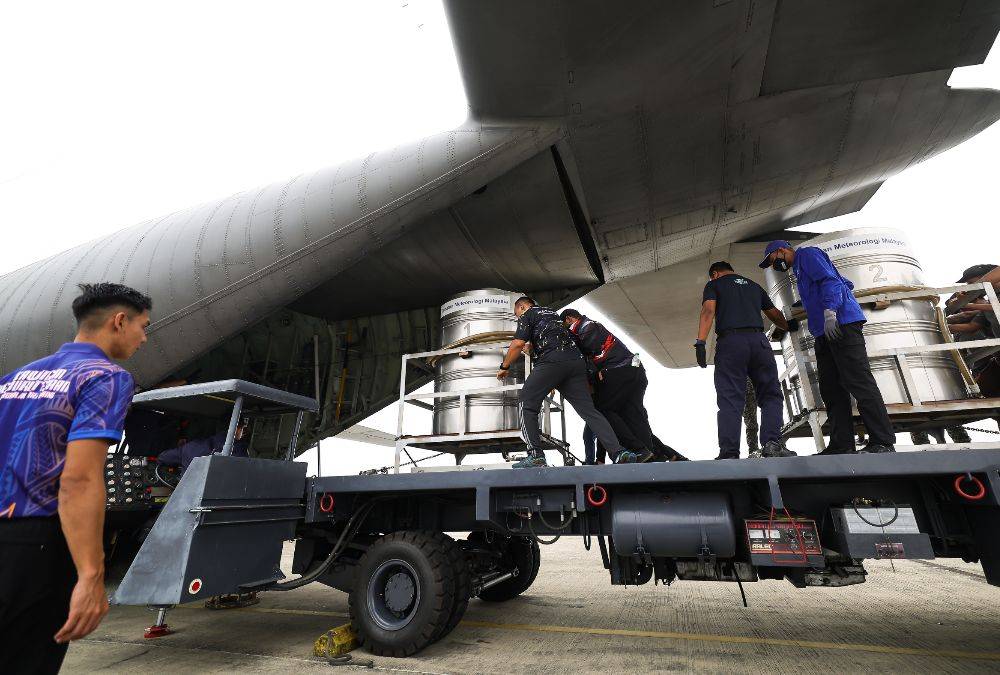
That growth spurt is no small feat. MetMalaysia says a cloud droplet needs to expand by around one million times before it is heavy enough to fall as rain.
But before anyone imagines rain on demand, a reality check: the World Meteorological Organisation (WMO) is clear that weather modification cannot summon a rain-bearing cloud system out of thin air, nor can it redirect the wind to march water vapour into a dry patch of sky.
Cloud seeding only works with what is already there, existing clouds and atmospheric conditions that are already leaning towards rain.
In other words, it is a nudge, not a magic wand. No suitable clouds, no seeding success.
That is also why cloud seeding turns up during haze season. It can encourage rain that helps clear the air, but it is not a pollution vacuum. Think of it as an assist, not a fix.
Even then, results are not one-size-fits-all. The WMO notes that how well seeding works depends on the type of cloud and the surrounding atmosphere, so a successful trial in one location will not necessarily repeat itself elsewhere.
So no, scientists are not conjuring rain out of nowhere. They are simply helping clouds that already have the ingredients for rain turn that potential into something wetter, faster.
Download Sinar Daily application.Click Here!