Permata Seni Koir goes for two golds, comes home as overall champions
26 young Malaysian singers surprise themselves with overall victory at international choir festival in Germany


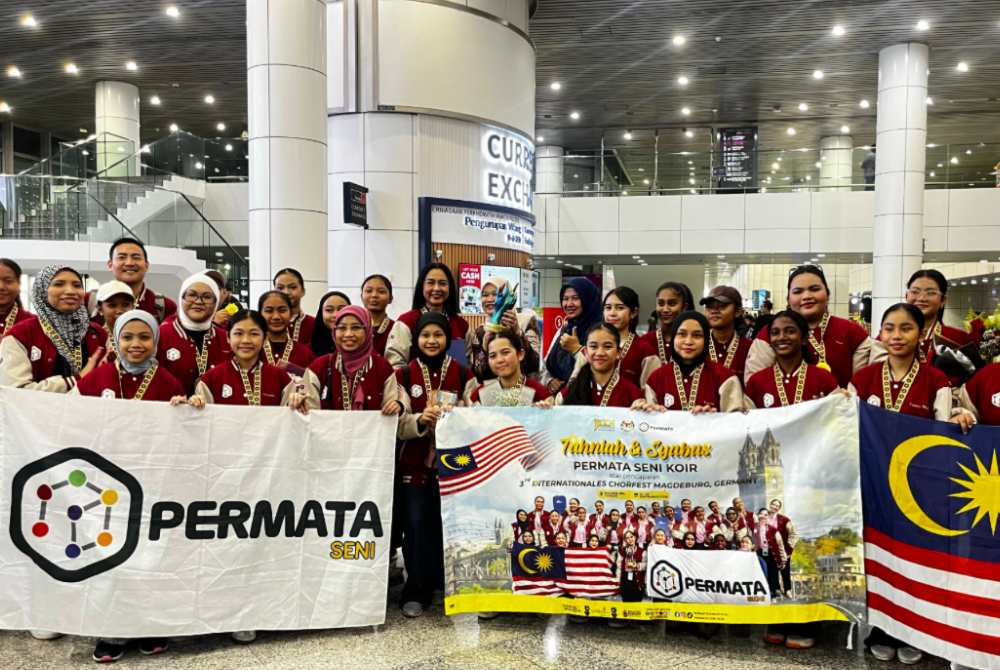
SHAH ALAM – When 26 young voices from Permata Seni Koir stepped onto the stage in Magdeburg, Germany, they were not thinking about becoming champions.
They did not even know there was an overall winner award.
For Permata Seni Koir division head and conductor Datuk Syafinaz Selamat, the plan was much simpler: do their best, win the gold and give the children a memorable experience.
Instead, the young Malaysians came home as the overall champions of the 3rd Internationales Chorfest Magdeburg, after collecting gold awards in both the Children’s Choir and Folklore categories.
The competition, held from Sept 14 to 23, saw the Malaysian group score 29 out of 30 points to emerge as the overall winner, despite competing against older and more experienced groups.
“Honestly, I did not expect us to win. We did not even know there was an overall winner award. We were just happy to go home with two golds.”
“I think that is what made the win so special. I knew what had gone on behind the scenes – the nerves, the long rehearsals and all the struggles along the way,” she said when contacted recently.
The victory was officially celebrated by the Education Ministry, which congratulated Permata Seni Koir for bringing home the overall title and praised the commitment, discipline, determination and teamwork shown by its young performers.
But behind the medals and applause was a much quieter challenge: teaching 26 individual children to stop thinking as individuals and start thinking as one choir.
“The hardest part was not teaching them the songs. It was getting 26 individual singers to stop thinking as individuals and start thinking as one choir,” Syafinaz added.
That meant hours of listening to one another, learning how to blend their voices and finding the right balance between melody and harmony.
It also meant learning to breathe together, move together and respond to the conductor’s gestures as one group.
Even their appearance on stage mattered, with their posture, movements and expressions needing to be synchronised.
Every singer also had to understand that what they did could affect the entire performance.
“Once they started thinking as one, everything else became much easier because they were all in sync,” she said.
The journey to Germany was hardly smooth.
The children had to juggle school, tuition, other activities and choir training, leaving them with limited time to rest.
Some fell sick, some lost their voices and even the haze became another challenge.
At one point, some of the soloists were unwell, forcing the team to prepare understudies who could step in if necessary.
For Syafinaz, it was a worrying prospect after months of preparation.
The group had started preparing in April, training twice a week for two and a half hours per session.
Their sessions covered singing, music theory and aural training, while the children also had to learn choreography alongside their vocal parts.
Then came another challenge in Germany.
Each competing group was given only 10 minutes to familiarise themselves with the stage and its acoustics before performing.
For a choir accustomed to spending an hour or even two on sound checks, 10 minutes was a major challenge.
“We really had to plan the sound check beforehand so we would not waste any time and everyone could get comfortable with the stage,” Syafinaz said.
Yet when the children finally stepped onto the stage, the fears seemed to disappear.
“They were fearless.
“They managed to stay focused. When they finally stepped onto the stage, they gave it their all and performed with so much energy,” she said.
That energy eventually turned into an unexpected 29-point score and an overall championship.
And then came the tears.
When the result was announced, the children cried. Syafinaz cried. Her assistants cried.
The pianist and four assistant conductors were also overwhelmed by the moment.
“Everyone was just overwhelmed. They were crying and screaming with joy because they genuinely did not expect to win,” she added.
For Syafinaz, however, the most meaningful part of the journey was not the trophy.
It was watching the children change along the way.
She noticed some of the older members naturally stepping into leadership roles, helping younger singers, correcting their friends’ intonation, reminding them about choreography and calming them down when they became nervous.
If someone struggled, someone else would notice.
The children gradually became more responsible not only for their own performance, but also for one another.
“They developed this feeling of being a family, regardless of race or religion. That is something you do not see when you simply watch these kids perform on stage,” Syafinaz said.
The experience also changed how the children saw themselves.
Syafinaz said the young singers discovered that they did not have to be the most experienced performers in the room to make an impact.
They had entered the competition as one of the youngest choirs, but stood alongside groups with considerably more experience and still emerged as the overall champions.
For 14-year-old Valerie Soh Yue Yun, the victory was a reflection of the group’s hard work and close cooperation.
“I am very happy to take part in this competition. We worked very hard to deliver an excellent performance. We did not expect to become the overall champion,” she told Bernama.
The youngest member, 12-year-old Tarshanaa Suresh, said the experience was about more than winning.
For her, the competition brought new friendships while teaching her the importance of teamwork and discipline.
Permata Seni Koir eventually took home a Gold Diploma Level 7 with 26.78 points in the Children’s Choir category for its performances of Jenny, Song of Hope and Ardi Bertuah.
The group also won the Folklore category with a Gold Diploma Level 9 after scoring 29 points for Sewang, Tari Tualang Tiga and Jong Jong Inai.
At KL International Airport upon their return, the young performers were welcomed by Education Minister Datuk Seri Fadhlina Sidek and performed Sewang and Enjut at the arrival hall.
For Syafinaz, the applause and trophy may eventually fade, but she hopes the children will carry something more lasting from their journey.
“Beyond the trophy, I hope the children take away the confidence to believe in themselves. Being at the top is not about age, but about hard work, discipline, commitment and teamwork.” she added.
She hoped they would never underestimate themselves because of their age or background.
“They represented Malaysia on an international stage, and I hope they carry that experience with pride and confidence.
“Most importantly, I want them to believe in themselves and in what Malaysians are capable of. We are just as good, and we are on par with the rest of the world. With the right dedication and opportunities, we can be even better,” she said.
Download Sinar Daily application.Click Here!