Japan launches new banknotes
The current banknotes will remain legal tender following the circulation of new bills, according to the Finance Ministry and the Bank of Japan.

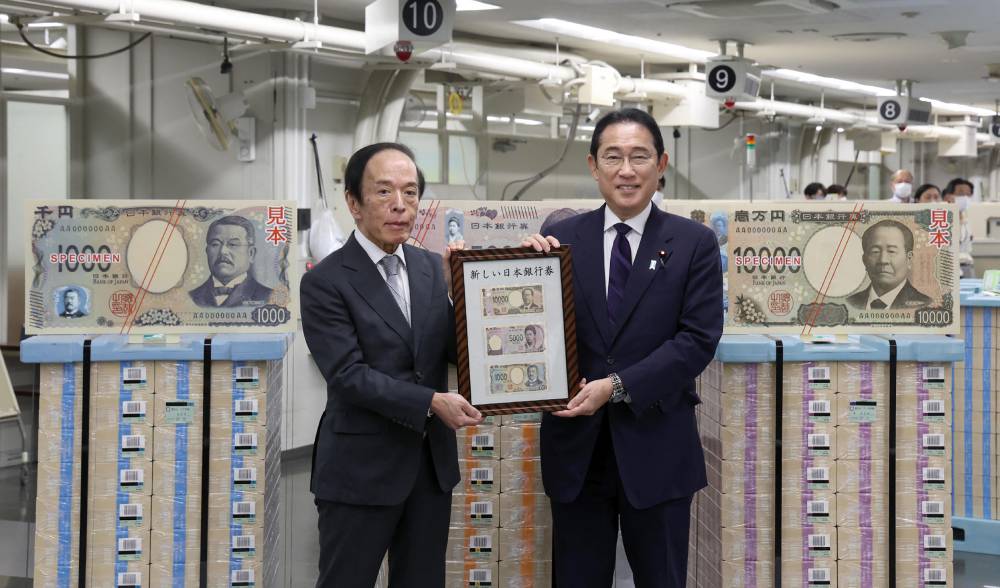
TOKYO - Japan on Wednesday started issuing new 10,000 yen (61.9 U.S. dollars), 5,000 yen and 1,000 yen banknotes, which marked the first redesign since 2004.
The current banknotes will remain legal tender following the circulation of new bills, according to the Finance Ministry and the Bank of Japan.
The redesigned 10,000 yen bill features the portrait of industrialist Eiichi Shibusawa, known as the "father of Japanese capitalism" and "pioneer of modern Japanese society," who was involved in the establishment of around 500 companies during his lifetime.
Featuring a female image for the first time, the portrait of Umeko Tsuda, an educator who pioneered women's higher education, will be carried by the new 5,000 yen bill,
Meanwhile, the new 1,000 yen note features microbiologist Shibasaburo Kitasato, who developed a serum therapy for tetanus.
The new banknotes incorporate three-dimensional hologram technology to combat counterfeiting, the first use on any country's currency.
Paper money, despite the spread of cashless payments, still serves as the main payment method in Japan, Japanese Finance Minister Shunichi Suzuki told a press conference on Tuesday.
Universal design that takes the visually impaired and foreigners into consideration has been incorporated into the new banknotes, he added.
On the new bills, the tactile mark is shaped to 11 diagonal lines for excellent finger sensitivity, while being placed in a different position to make it easier to identify denominations.
Arabic numerals are used for face value numbers and have a larger font than that of current notes. (1 Japanese yen equals 0.0062 U.S. dollars). - XINHUA
Download Sinar Daily application.Click Here!