Syed Saddiq pushes for tougher actions to stop violence in schools
He said in developed countries, wardens are held accountable, principals face consequences, blacklists are issued and enforcers who act slowly are also dealt with.
NUR ADNIN MAHALIM
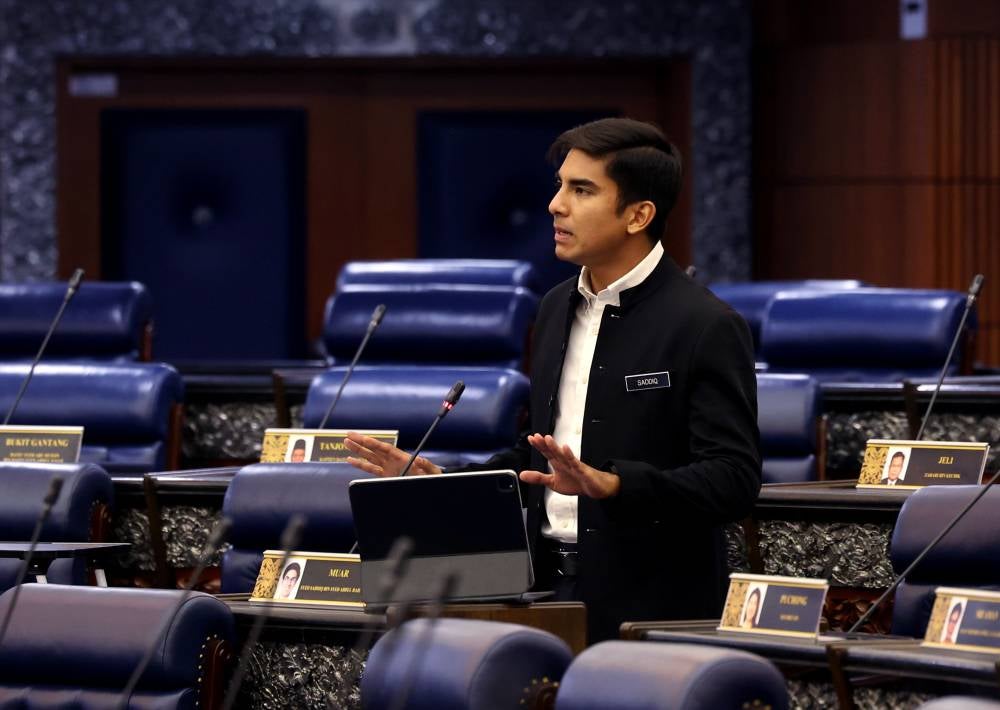
SHAH ALAM - Each time tragedy strikes, a student assaulted, another found dead, the public hears the same reassurances: "Action will be taken." Yet, behind the scenes, the system rarely punishes itself.
Muar MP Syed Saddiq Syed Abdul Rahman said despite countless promises and policies, there remained little to no evidence that anyone within Malaysia’s education system has ever been held accountable when such incidents occurred.
He said despite repeated incidents of bullying, assault and even murder, no wardens, principals or enforcers have been held responsible, describing it as a sign that the system continued to shield itself from scrutiny.
"I’ve raised this in past speeches. Every time I do, the government responds by saying 'action will be taken, don’t worry, (people) from top to bottom (ranks).'
"Show me one piece of evidence. Where are the enforcers, the wardens, the principals, the system (that have been held accountable)? Not a single one has been taken action against," he said during a parliament session, yesterday.
He said in developed countries, when bullying occurred, the system acted and the principals and teachers were answerable.
"In developed countries, wardens are held accountable, principals face consequences, blacklists are issued and enforcers who act slowly are also dealt with," he said.
However, he said, here, responses often focused not on accountability, but on protecting a school’s "reputation."
He added that what worried him more was that after cases of murder or rape in schools, ministry officials in interviews or media ambushes would often focus on defending the school’s reputation, saying things like "this is the best school (in the area)" instead of addressing the safety failures that led to the incident.
"Who cares if the school has a good name? If someone has been raped, killed or bullied, the school’s reputation is irrelevant. What matters is the safety of the children at school," he said.
He said recent cases of violence in schools including the case of Zara Qairina Mahathir, 13, the Johor bullying incident that caused brain trauma, a recent gang rape that was brazenly recorded on video and the stabbing of a 16-year-old student, showed how schools were no longer the safe spaces they were meant to be.
"Schools are like our second homes. Teachers are like parents at school.
"A place that should be the safest after our own homes is now no stranger to words like murder, rape and bullying," he said in his speech.
He also highlighted that for children from middle-income and B40 families, public education represented their greatest hope.
It remained the most powerful tool to break the cycle of poverty, he added.
"I’ve shared data and statistics showing that national schools used to be the top choice not only for middle-class and B40 families but also for the wealthy.
"But year after year, this trend has changed. It’s not just people from certain ethnic groups who no longer choose national schools as their primary option, now even many Malays from the middle class are turning away from them," he said.
In his speech, he also presented three proposals to address the issue, beginning with a call to immediately approve funds to install closed-circuit television (CCTV) cameras in all national schools.
"Don’t use excuses that this requires a large budget. I checked and found that you can buy a CCTV unit for RM50. If you want something more advanced with solar power, RM200. If each school installs 20 units, it’s not much.
"Malaysia has 10,000 schools. The cost isn’t that high. Even if it is, if it saves even one life, it’s a cost we must bear," he said.
He also proposed for the government to investigate and dismantle the systems that protected bullies, noting that in developed countries, accountability extended beyond the perpetrators.
The third proposal he made was for the reintroduce the "you touch, you go" policy and enforce a zero-tolerance stance against bullying.
He said the government must investigate swiftly, prosecute and issue strong statements to send an unequivocal message that bullying, no matter how small, will not be tolerated.
Download Sinar Daily application.Click Here!


