Three-year-old now bedridden after rare brain damage from Influenza A
Before falling ill, Aish was an active, cheerful boy who could already recognise colours and recite the alphabet from A to Z.


SHAH ALAM – For any mother, there is no greater pain than watching a once lively child lose the ability to move, speak or even respond.
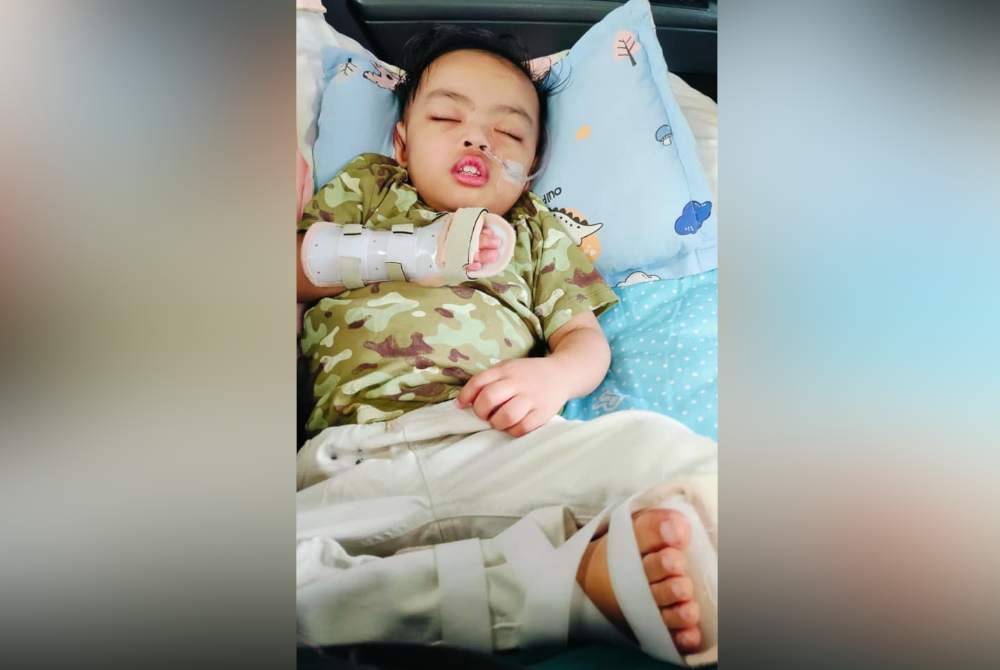
That is the heartbreaking reality faced by 31-year-old homemaker Siti Nur Shafiqa Suraini, whose three-year-old son, Muhammad Aish Irfan Mohammad Hakeem, was diagnosed with Acute Necrotising Encephalopathy of Childhood (ANEC), a rare and severe form of brain damage caused by an Influenza A infection.
Before falling ill, Aish was an active, cheerful boy who could already recognise colours and recite the alphabet from A to Z.
“That night, he was still playing and drinking milk as usual before bed. But around 4.30am, he suddenly cried loudly, vomited and his body temperature spiked to 39.8 degrees Celsius.
“We rushed him to Hospital Melaka because he had become weak and unresponsive when I called his name,” Siti told Sinar Harian.
Upon arrival at the emergency department, Aish’s temperature had climbed to 41 degrees Celsius and his oxygen levels had dropped drastically, prompting doctors to place him in the Paediatric Intensive Care Unit (PICU).
“On the first day in the PICU, his oxygen level was still unstable and then his legs suddenly went weak. After a CT scan and MRI, doctors confirmed that Aish’s brain had suffered damage caused by Influenza A.
“On the second day, they had to sedate him and told us to prepare for any possibility,” she said.
Aish spent a month battling for his life in intensive care before his condition stabilised. However, the infection left lasting damage.
Today, the once talkative toddler has lost the ability to control his body, cannot speak and has to be fed through a tube. Doctors have classified him as a person with physical disabilities (OKU).
“The specialist told us his brain waves are still very slow. Now, Aish can only show emotions, he can smile or cry, but he cannot talk or move on his own.
“I feed him every two hours and give him his medicine on schedule, while his father carries and bathes him daily,” Siti said softly.
Aish, the eldest of three siblings, continues to receive follow-up treatment from five different specialists, including neurology, paediatrics, dermatology and infectious disease experts. He also undergoes four forms of therapy - physiotherapy, speech, occupational and rehabilitation therapy.
However, the family’s financial situation remains a challenge.
“Private physiotherapy sessions cost RM150 for just 20 minutes. There are therapy sessions at government hospitals too, but we only get appointments every two or three months.
“We do receive RM500 in monthly assistance from the Social Welfare Department (JKM) for bedridden Person with Disabilities (PWD) cases, but it’s still not enough to cover all the treatment and rehabilitation costs,” Siti said.
A video of Aish recently went viral on TikTok, garnering over 300,000 views and thousands of supportive comments from Malaysians touched by his story. Many have offered prayers for his recovery and words of encouragement for the family.
Despite the pain and exhaustion, Siti continues to hope for a miracle.
“I just pray that Aish will one day be able to walk, talk and laugh again, just like before,” she added.
Those who wish to offer assistance can contact Siti Nur Shafiqa via her TikTok account @IbuAish.
Download Sinar Daily application.Click Here!