Approved plans alone cannot guarantee hillside safety, experts warn
Heavy rainfall, poor drainage and inadequate slope maintenance can increase landslide risks, following a fatal incident in Paya Terubong, Penang


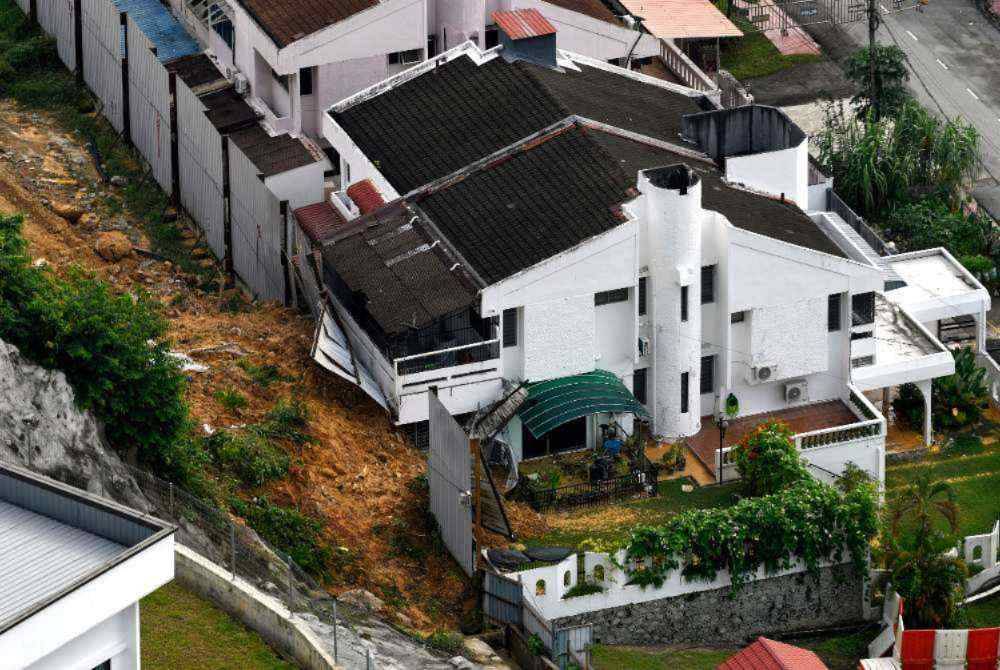
SHAH ALAM – Approved engineering plans alone may not be enough to ensure the safety of hillside developments, as extreme rainfall, inadequate drainage and poor slope maintenance can increase the risk of landslides, experts warn following a fatal incident in Paya Terubong, Penang.
Geologist Professor Dr Azmi Hassan said hillside development risks could be managed through proper engineering, but extreme weather and unpredictable natural conditions meant that safety could not be guaranteed by planning alone.
“There should not be a problem with hillside development from an engineering point of view, provided factors such as soil conditions, earthworks, drainage systems, slope stability and gradient are properly addressed.
“However, planning and nature do not always go hand in hand. With the monsoon season approaching and the possibility of extreme rainfall, problems can still arise, regardless of how carefully a development is planned,” he told Sinar Daily.
Azmi said restrictions on hillside development were still necessary, particularly in areas already known to be prone to landslides.
“As Sahabat Alam Malaysia has warned the state government, Paya Terubong is an area prone to landslides. Even if developers follow the approved plans, it is difficult to contend with nature,” he added.
He said heavy rainfall and the accumulation of rainwater could contribute to landslides, adding that avoiding development in vulnerable areas was preferable wherever possible.
“While hillside developments do not always lead to problems, I believe we should avoid developing these areas wherever possible. If we can avoid the risks altogether, then we should,” he said.
Azmi said a key challenge was determining whether engineering designs and drainage systems could adequately manage extreme weather, particularly when large volumes of rain fell within a short period.
He said changing weather patterns could make it increasingly difficult for engineers to anticipate how slopes would respond to heavy rainfall, even when developments were approved based on their engineering plans.
“The risks are even greater when dealing with slopes, particularly in terms of water runoff, structural changes to the slope and heavy loads placed on top of it,” he added.
Universiti Kebangsaan Malaysia (UKM) geohazard and engineering geology expert IR Dr Goh Thian Lai said slope stability depended on soil properties, cut-slope design and the effectiveness of slope mitigation systems.
He said steep slopes and unfavourable soil conditions could increase the risk of failure, while human activities and rainfall could trigger landslides.
Goh said inadequate slope maintenance could also reduce drainage efficiency, allowing water to overflow or seep into the soil and increase pore water pressure, weakening the ground.
“In addition, human activities on cut slopes often remove vegetation, allowing surface runoff to fall directly onto the bare ground and erode soil particles.
“This increased volume of sediment-laden runoff can quickly overwhelm the existing drainage system,” he said when contacted recently.
He added that a development could become unsafe even if its original plans had been approved, particularly when poor workmanship left the soil inadequately protected against erosion.
“Poor workmanship contributes to inadequate soil protection and leads to higher soil erosion, especially during heavy rainfall,” he added.
To improve safety, Goh proposed installing Internet of Things (IoT)-based sensors on high-risk slopes to monitor ground conditions in real time and provide automated alerts when potential hazards were detected.
He also suggested installing temporary barriers at the base of slopes to intercept landslide material, alongside regular inspections by geotechnical specialists at critical locations.
Goh said authorities should identify high-risk slopes and alert nearby communities so residents could recognise the dangers and evacuate promptly when early signs of slope failure emerged.
He added that public education programmes and disaster drills should be conducted alongside continuous monitoring to help communities recognise warning signs before a disaster occurred.
The concerns follow a landslide in Taman Seri Rambai, Paya Terubong, that claimed the life of a 73-year-old doctor and prompted the evacuation of residents from six houses near the affected slope.
Authorities subsequently issued stop-work orders for a nearby housing development and slope stabilisation works pending safety inspections, after continued ground movement raised concerns about further collapses.
Northeast District Officer Ismasuhaimi Shariff was previously reported as saying that preliminary investigations identified a leaking water channel and a clogged drain that had allowed water to flow into the affected house, contributing to soil movement.
He also warned that a crane and a large concrete block at the construction site could pose additional risks if the ground shifted further.
The development comprises 1,670 affordable housing units in two blocks, an eight-storey underground car park and other facilities.
Although slope stabilisation measures, including a retaining wall, were in place, the section where work was still ongoing gave way during the incident.
Penang authorities said technical assessments by the Minerals and Geoscience Department and the Public Works Department were needed to determine the slope’s condition and whether affected residents could safely return home.
The incident has also renewed concerns over development in environmentally sensitive areas, with Sahabat Alam Malaysia president Meenakshi Raman calling on the state government to explain whether adequate slope monitoring and mitigation measures had been implemented.
Download Sinar Daily application.Click Here!