Are we reading less and trusting AI more? Four words Oxford says define 2026
Its language experts have shortlisted four contenders for the Oxford Word of the Year 2026 after analysing a 32-billion-word corpus of language data.


SHAH ALAM – Ever watched a video online and wondered whether it was real or generated by artificial intelligence (AI)? Or found yourself scrolling through one short video after another, only to realise you have spent an hour on your phone?
Perhaps you have also come across someone convinced that the world is heading for disaster, no matter what happens.
Apparently, there are words for some of these experiences, and Oxford University Press (OUP) thinks they say quite a lot about the year we have had.
Its language experts have shortlisted four contenders for the Oxford Word of the Year 2026 after analysing a 32-billion-word corpus of language data.
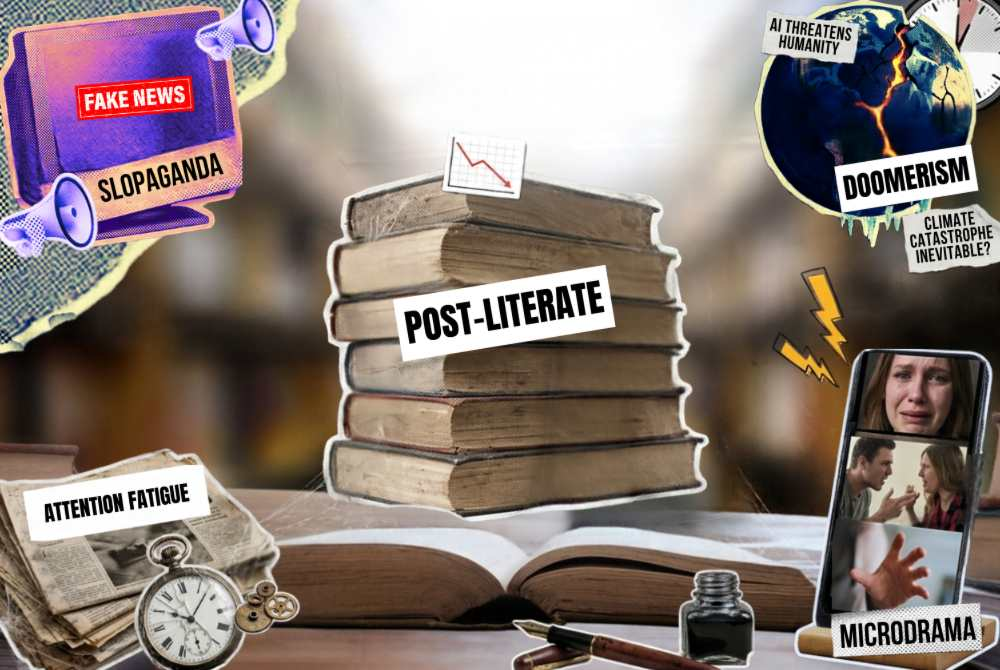
The words are slopaganda, doomerism, microdrama and post-literate. While they may sound unfamiliar at first, their meanings touch on things many people encounter in their everyday lives, from questionable online content to changing reading and entertainment habits.
So, what do they actually mean?
Slopaganda
You have probably seen those strangely convincing AI-generated videos circulating on social media. Some are amusing, some are downright bizarre, while others can leave viewers questioning whether what they are watching is even real.
But what happens when AI-generated content is used to push misleading messages or influence what people think?
Enter slopaganda.
A blend of “slop” and “propaganda”, the term refers to low-quality propaganda created using generative AI and distributed widely online, particularly through social media.
The word builds on “slop”, which was already on Oxford's 2024 shortlist. It describes low-quality AI-generated content that is shared indiscriminately, often with little regard for whether it is authentic or accurate.
Slopaganda was apparently first used in its current sense in 2025 by academic researchers writing in a philosophy journal.
Its use has since taken off, with OUP reporting an increase of more than 1,300 per cent in relative frequency over the past year.
The concern goes beyond the sheer amount of AI content being produced. OUP said the growing use of the term reflects public unease over how such material could be used to manipulate opinions, particularly when political messaging is involved.
In a world where a video can be generated in minutes and shared with thousands of people, knowing what to trust has become an increasingly important question.
Doomerism
AI is advancing too quickly. Climate change is getting worse. The future looks uncertain.
If conversations about the world often leave you feeling that everything is going downhill and there is nothing anyone can do about it, you might recognise the thinking behind doomerism.
Oxford defines the word as extreme pessimism, particularly the belief that catastrophic damage to humanity from threats such as AI or climate change is inevitable and impossible to prevent.
It comes from “doomer”, a term used to describe someone with an extremely pessimistic outlook, combined with the suffix “-ism”.
The word has been growing in use since 2022, but its frequency nearly doubled in 2026, according to OUP.
That increase is closely tied to discussions about the pace of AI development, concerns over safeguards in the technology industry and fears about the world's climate targets.
Oxford also pointed to the effect of repeatedly being exposed to warnings about technological threats and environmental catastrophe.
There is a difference between being concerned about the future and believing that disaster is unavoidable. Doomerism captures the latter, a mindset in which hope can begin to feel pointless.
Microdrama
Not everyone has the time or patience to sit through an entire television episode these days. Sometimes, all it takes is a few minutes, a phone screen and a storyline dramatic enough to keep viewers coming back.
That is where microdramas come in.
The term describes drama series made up of very short episodes, usually filmed in vertical format for smartphone viewing. Expect fast-moving plots, plenty of drama and episodes designed for audiences who want their entertainment in smaller portions.
The word combines “micro-”, meaning small, with “drama”.
The format originated in China, where it is known as “duanju”, meaning a short play or show. Interestingly, the word microdrama itself is not new, with Oxford tracing earlier examples back to 1862.
What has changed is how popular the format has become.
Its use increased threefold in 2026, reflecting the growing appetite for short-form entertainment and the way smartphones have changed how people watch stories.
From watching during a commute to squeezing in an episode while waiting for food, microdramas fit neatly into the small pockets of time that make up everyday life.
Post-literate
Be honest: when was the last time you finished a book without getting distracted by your phone?
For many people, reading now competes with an endless stream of social media posts, short videos and other digital content. It is this shift that makes the word post-literate particularly interesting.
Oxford uses the adjective to describe a period or society in which literacy and the importance of the written word have declined significantly.
The term combines “post-”, meaning after, with “literate”. Although it appeared as early as the 1940s, its more recent use focuses on concerns that reading is becoming less valued.
OUP linked its inclusion in the shortlist to changing leisure habits and the growing influence of digital technology, short-form videos and AI-generated material.
The concern is not simply that people are reading fewer books. Reports of declining reading habits have also raised questions about what could happen to skills such as critical thinking and empathy, as well as people's ability to identify misinformation.
In other words, post-literate is about more than putting down a book. It asks what happens when reading and engaging with written information no longer play the same role in our lives.
So, which word sums up your 2026?
Taken together, the four words paint a picture of a year shaped by technology, uncertainty and changing habits.
We are questioning what we see online, worrying about what the future holds, consuming entertainment in shorter bursts and reconsidering the place of reading in our daily lives.
OUP said its annual selection involves analysing emerging words and changes in language, while also considering public suggestions and influential events from the past 12 months.
The four shortlisted words are now open to public voting until Nov 24, with the winning Word of the Year set to be announced on Dec 1.
Download Sinar Daily application.Click Here!