Why is cable theft on the rise in Malaysia?
Cable theft has escalated into a major problem, with a flurry of high-profile incidents in recent months.
HAJAR NAZLI
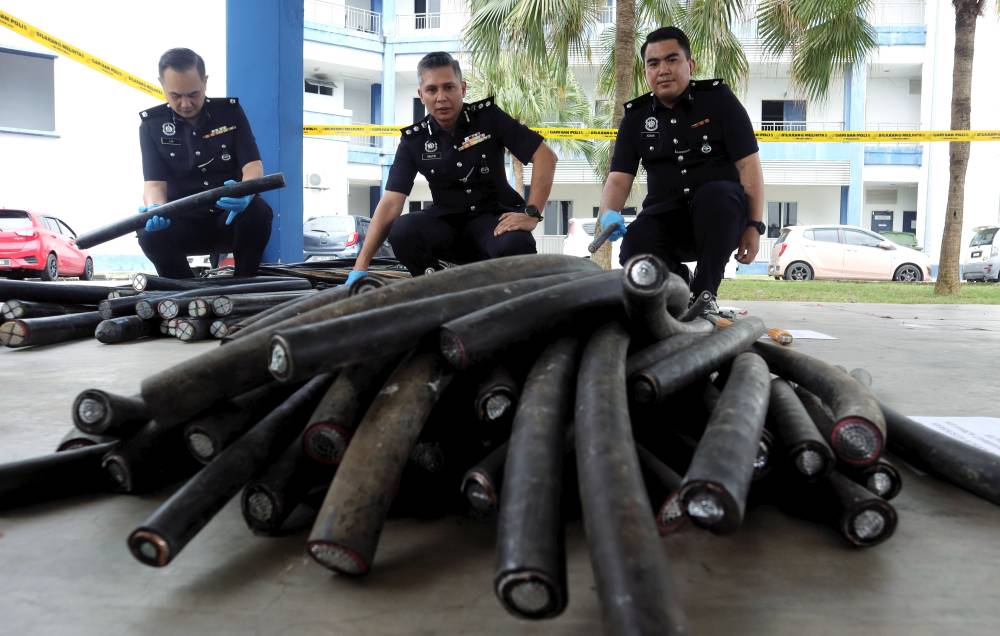
SHAH ALAM – Soaring copper prices, easy resale channels and light penalties are fuelling a sharp rise in cable theft nationwide, with rail networks and telecommunication industry bearing the brunt.
Copper is vital to power transmission, transportation, construction, consumer electronics and electric vehicle production.
As global supply tightens and demand surges from green energy electrification and data centre expansion, prices have spiked.
London benchmark prices climbed from US$9,623.50 (about RM39,340) a tonne in March 2025 to US$12,860 (about RM52,571) in early March this year, after a record US$14,527.50 (about RM59,388) in January.
Local scrap metal dealers currently list copper scrap at between RM41 and RM45 a kilogramme, depending on grade and quality.
In Malaysia, cable theft has escalated into a major problem, with a flurry of high-profile incidents in recent months.
Just recently, police said they were tracking down a group suspected of stealing cables in front of the TREC premises on Jalan Tun Razak after the incident went viral on social media.
Kuala Lumpur police chief Datuk Fadil Marsus said police received a report on a 38-second video uploaded on Threads at about 9.50am on Saturday (Nov 21).
"Preliminary investigations found that the suspects arrived in two vehicles and were cutting the cables at the location in the open," he said in a statement.
He said the group fled after being confronted by members of the public, and efforts were under way to identify and arrest them.
The case is being investigated under Section 235 of the Communications and Multimedia Act 1998 and Section 379 of the Penal Code for theft.
What thieves stand to earn
Prasarana Malaysia Bhd reportedly said thieves targeting the urban rail network can earn between RM60,000 and RM100,000 from a single theft, according to its Health, Safety, Security, Environment and Sustainable Development group chief Idzqandar Abu Bakar.
A media report said 200 metres of stolen rail cable fetches about RM5,000 to RM10,000 on the black market.
Who buys the cables
Home Minister Datuk Seri Saifuddin Nasution Ismail previously said thieves mainly target signal and power supply cables, which fetch high resale value from scrap metal dealers.
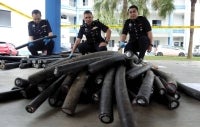
A media report in June last year revealed that a syndicate sold stolen Telekom Malaysia and Tenaga Nasional Bhd cables worth RM700,000 to scrapyards in Semenyih, Selangor, in 23 separate transactions since 2024.
A penalty critics call too light
The government is finalising amendments to rail transport laws to raise the maximum fine for railway cable theft from RM1,000 to RM100,000 per offence.
Deputy Transport Minister Datuk Hasbi Habibollah said the proposal is expected to be tabled in the coming Parliament sitting, adding that current penalties are far too lenient compared with the financial losses and disruption caused.
Idzqandar said prison sentences of just three to four months have failed to deter repeat offenders.
Housing and Local Government Minister Nga Kor Ming said yesterday that the government, through the Home Ministry, is looking at amending existing laws on cable theft to impose heavier punishments. He said LRT and MRT services were frequently disrupted not by operational failure but by syndicates stealing cables.
Cost to the rail network
Cable theft across the railway network has caused more than RM50 million in losses since 2024, according to the Transport Ministry.
Hasbi said Keretapi Tanah Melayu Bhd (KTMB) was hardest hit, with 432 cases and nearly 20,000 metres of cable stolen between 2024 and June 2026.
The disruptions caused delays last year totalling 246 hours for the Electric Train Service (ETS) and 135 hours for KTM Komuter.
Prasarana reported 163 cable theft cases across its MRT and LRT networks, with estimated damage of RM29 million. Incidents spiked in July and August last year, accounting for 72 of the cases.
The East Coast Rail Link (ECRL) project has also been hit, with 71 cases and RM4.06 million in losses as of Jun 8.
What is being done
The government is installing 1,146 CCTV cameras along train lines from Johor to northern Malaysia.
Besides securing manholes and deploying K9 units, KTMB has given its Auxiliary Police force 20 scrambler motorcycles for patrols.
Extracting the heavy cables typically takes two to three hours, giving security personnel a wider window to detect and intercept suspects.
Download Sinar Daily application.Click Here!