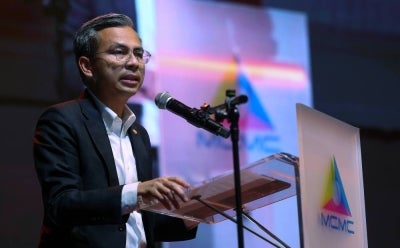
Malaysia must prepare for quantum migration process, says Fahmi
"What we are seeing is that the global trend is moving towards not just quantum cryptography, but also quantum-safe communication."


KUALA LUMPUR - Malaysia must strengthen its preparedness for the quantum migration process, with a focus on quantum-safe communication, to ensure the security of the country's digital infrastructure and data, said Communications Minister Datuk Seri Fahmi Fadzil.
He said the Communications Ministry, through the Malaysian Communications and Multimedia Commission (MCMC), prioritised the security of digital infrastructure, including telecommunications networks, towers and fibre-optic cables.
"What we are seeing is that the global trend is moving towards not just quantum cryptography, but also quantum-safe communication to ensure that all data transmitted through telecommunications lines, microwave frequencies and other channels cannot be infiltrated, stolen or hacked by criminals,” he said.
He was speaking at a press conference after officiating NEXSEC 2026: Advancing Cyber Resilience Through Collaboration, Innovation and Talent, here today.
Also present were Communications Ministry Deputy Secretary-General (Telecommunications Infrastructure) Mano Verabathran, National Security Council (NSC) Director-General Datuk Raja Nushirwan Zainal Abidin and MCMC Chairman Tan Sri Mohamad Salim Fateh Din.
Fahmi said he had instructed MCMC to organise a research and development (R&D) roundtable discussion and follow-up initiatives involving most mobile network operators, telecommunications infrastructure companies and telecommunications tower companies to assess preparations for the challenges of the post-quantum era.
He said the move was important to ensure that the country's information architecture infrastructure was ready to face increasingly complex technological challenges, particularly as the world approaches the post-quantum era.
On another matter, Fahmi said the government would maintain its dual 5G network policy to provide users with confidence and ensure service continuity in the event of disruption to either network.
"The dual network policy also provides what is known as redundancy. Should anything happen to one network, the second network can be activated,” he said.
He added that he had also asked both network operators to hold discussions to enable users to continue receiving services through an alternative network in the event of an emergency or disruption.
NEXSEC 2026, organised by MCMC, is being held today and tomorrow, bringing together representatives from the government, security agencies, industry, higher education institutions and ASEAN member countries to strengthen the nation's cyber preparedness and resilience.
MCMC also signed a memorandum of understanding (MoU) with the National Cyber Security Agency (NACSA) to enhance information sharing on cyber threats, response coordination and capacity building between the two agencies, in line with their respective functions and jurisdictions.
The official Global Anti-Scam Alliance (GASA) report, "State of Scams”, was also presented to Fahmi. Among other findings, it estimated that losses from scams in Malaysia had reached RM19.7 billion over a one-year period, underscoring the importance of strengthening prevention efforts and consumer protection.
Earlier, in his officiating speech, Fahmi said the country needed to pay greater attention to the security of its information architecture and quantum-safe communication, in line with developments that had also become a priority for many countries.
He said efforts to strengthen digital infrastructure security also required more careful financial planning and resource allocation, as the development of such technology involved substantial costs.
"There’s no point in having first-class, first-world information infrastructure or information architecture if it’s not also coupled with first-class cybersecurity,” he said.
Meanwhile, Fahmi said NEXSEC 2026 was an important platform for highlighting developments in cybersecurity and enabling the government and industry players to exchange views on current challenges and measures to address them.
He said the GASA report presented at the event documented several government initiatives to tackle online scams, including measures taken by MCMC and telecommunications companies at the network level.
He said that although some of these initiatives had yielded results, criminals would continue to seek new opportunities to carry out their activities.
"And some of these efforts have borne fruit, but as our colleagues from PDRM (the Police) can confide or attest, you close one door, these nefarious actors will find a different door, a different window, a small crack through which they will come through,” he said. - BERNAMA
Download Sinar Daily application.Click Here!