A princess in the Garden of Knowledge
Valedictory speech at the International Islamic University Malaysia (IIUM) convocation ceremony on Nov 28, 2026


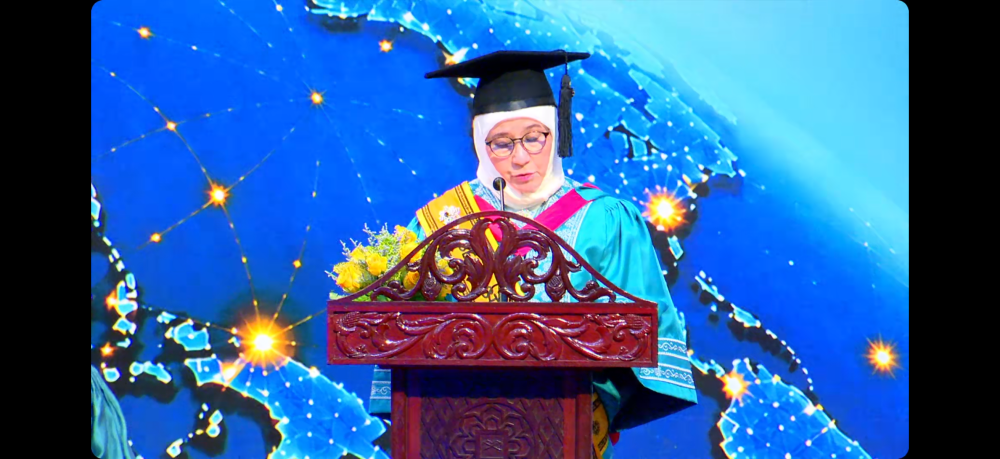
Bismillahirrahmanirrahim.
Assalamualaikum warahmatullahi wabarakatuh.
Selawat
Mengadap Ke Bawah Duli Yang Maha Mulia Paduka Seri Sultan Perak Darul Ridzuan, Sultan Nazrin Muizzuddin Shah and Duli Yang Maha Mulia Raja Permaisuri Perak Darul Ridzuan, Tuanku Zara Salim
My beloved husband Kebawah Duli Paduka Baginda Al-Sultan Abdullah Riayatuddin al Mustapha Billah Shah, the Sultan of Pahang;
My dear son, the Tengku Mahkota of Pahang, my dearest children and family;
The President and Rector of IIUM;
Distinguished guests, fellow graduates, and my dear friends.
Before I begin, I seek Kebawah Duli Tuanku Sultan of Perak's indulgence. Although Your Royal Highness is the more senior Sultan and has graciously consented to confer my degree, my first thank-you must go to my husband.
Kebawah Duli, you confer the degree but he is still the boss!
As a wife and a Muslim, my devotion and loyalty to him come first. To my beloved husband, thank you for your blessing, your encouragement and your support throughout this journey. You gave me the confidence to begin, and stood by me until I finished. Thank you for supporting my decision to return to university and for believing in me from the very beginning.
To Kebawah Duli Paduka Seri Sultan of Perak, thank you for making this day so special by conferring my degree. To Tuanku Zara, thank you for gracing this occasion. Having you both here means more to me than I can say.
To my dearest children, I will always remember your warning.
“Don’t embarrass us, Mama. Don’t stop halfway. Don’t miss class. Submit your assignments!”
After all those years of telling you to go to class, hand in your assignments and finish what you started, I discovered how enthusiastically you could return the favour. I had no idea you’d been listening so closely!
Well, children, this time I listened. And when I got the Best Student Award, what did you call me? “Teacher’s pet!” I thought the whole point was not to embarrass you! Thank you for your love, your encouragement and the supervision I do not recall requesting!
And now I can finally say it. Your Mama made it. And she did it with distinction!
To the President and Rector: if you ever quietly wondered whether I could deliver, I hope I have answered your question. Today, I stand before you as your student, delighted to have earned her place among these graduates.
And to IIUM, thank you for giving me the opportunity to return to university, and to study a history that is so close to my heart.
And to all my friends up there: who would have imagined this day?
I did it. I wrote the thesis. And if you have any doubts about that last part, you can ask Turnitin!
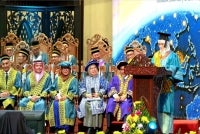
Some of you may have noticed that I entered the hall today with my beloved husband, The Sultan of Pahang, and the Sultan of Perak, who has graciously consented to confer the degrees upon all our graduates.
Then, rather suddenly, I turned away from the royal party and disappeared into the Master’s row. I assure you, this was not a mistake in protocol!
I entered this hall as Tengku Ampuan of Pahang. I sat among you as a student. I walked across this stage with my fellow graduates and received my scroll from the Sultan of Perak, just as every other graduate did. Then, I quietly found my way back up here to take my seat as Constitutional Head.
I have changed seats several times today, but I am still wearing the same Master’s robe. The seat represents the office entrusted to me. But this robe represents something I had to earn. And if anyone thinks the Constitutional Head received special treatment as a student, I have news for you. Even after the Senate endorsed my graduation, I could not get my academic transcript until I settled my outstanding fees.
I asked, “Fees? Haven’t I paid everything?” Apparently, I still owed RM2,200 for my thesis evaluation and RM250 for graduation fees. I paid, of course. So I can assure my fellow graduates: I earned this degree, and IIUM made sure I paid my fees too! And if all goes well, I shall need that transcript for the next adventure: my PhD.
And the graduation fees were not the end of it! Even after being nominated for the Best Thesis Award, I still had to complete the forms and provide supporting evidence, just like everyone else. Publications, citations, conferences, student activities, the list went on. By the time I finished, I felt as though I was applying for a professor’s job!
I hope I have satisfied every requirement, and that everyone in this hall understands and appreciates that being Constitutional Head gave me no special treatment as a student. I had to earn my place, do the work and fill in the forms. And today, that makes the scroll I hold all the more precious to me.
So, for this one special day, I do not stand before you only as the Constitutional Head of this University. I stand among you, proudly and humbly, as one of its graduates.
Today, I stand before you in two rather different capacities. One was entrusted to me by office: Constitutional Head of this University. The other had to be earned: that of a graduate.
As Constitutional Head, I usually sit upon this stage. As a student, I had to sit in the classroom, listen, complete my assignments and diligently write my thesis. At official functions, people sometimes wait for me. As a student, I discovered that deadlines wait for no one!
They say age is just a number. I returned to university at the age of sixty-four. I had always described myself as a “Jill of all trades and master of none.” Today, that description is no longer entirely accurate. At sixty-six, I have finally become a Master of one, and I have the degree to prove it!
I am sure that, at the beginning, my Rector and supervisors must have had some doubts about whether I could truly deliver. Perhaps they wondered whether they had accepted a Master’s student, or taken on a restoration project! But they never lowered the standard for me. They challenged me, corrected me and expected me to produce work worthy of the degree. For that, I shall always be grateful. They did not simply help me to complete a thesis. They helped me to believe that, after forty-five years away from formal education, I could still return, learn and excel.
Hādhā min faḍli Rabbī.
“This is by the grace of my Lord.”
Alhamdulillāh.
Beyond the laughter and celebration, this journey has taught me something that I wish to share with every graduate today. IIUM is known as the Garden of Knowledge and Virtue. For most of us, this is a familiar description. But while studying the Hukum Kanun Melaka and the Hukum Kanun Pahang, I discovered that the image of a garden carries a much older and deeper meaning within our own Malay-Islamic intellectual tradition.
The Hukum Kanun Pahang tells us:
“The rulers are like a gardener cultivating a garden. He plants each tree where it is most fitting.”
The passage explains that a wise gardener knows what to plant and where to plant it. Each tree should bring fruit, fragrance, shade or healing. If a tree no longer brings benefit and instead harms the garden, it must be removed and replaced.
This was not merely advice about trees. It was a philosophy of government.
The ruler was the gardener. The kingdom was the garden. The ministers and officials were its trees. Each person had to be chosen for moral character, wisdom, responsibility and the ability to benefit others. The Hukum Kanun requires rulers to appoint people of good reputation and sound character. Its officials must be just, vigilant, patient, courageous and capable of giving wise counsel. Authority was never simply a privilege. It was an amanah.
Long before modern universities spoke of epistemology or worldview, our own manuscripts were already teaching that knowledge cannot be separated from character, that authority must be joined with accountability, and that good government begins with good human beings.
Melaka gave birth to these principles. Pahang preserved and refined them. The Malay world inherited them. And today, here in IIUM’s Garden of Knowledge and Virtue, we are being taught those values once again.
Our lecturers did not merely give us information. They cultivated our judgment. They watered our curiosity, strengthened our roots and pruned our weaker arguments, sometimes quite severely! But that, too, is the work of a good gardener.
To all our lecturers, teachers and supervisors: thank you for guiding us with patience and for believing in what we might become. To our parents, spouses, children, families and friends: although our names appear on these degrees, we know that we did not make this journey alone.
Many of my fellow graduates are fortunate to have their parents here to see them graduate. Today, I am fortunate to have my husband and my children here to witness a moment I will always remember. They have been beside me throughout my scholarly journey, from the day I went back to university to study the history of Pahang to the day I could finally say, “I’ve finished my thesis!”
Once again, I offer my deepest gratitude to my beloved husband, Al-Sultan Abdullah Ri’ayatuddin Al-Mustafa Billah Shah, whose blessing allowed me to begin this journey and whose encouragement carried me through it.
I am also deeply grateful to my supervisor Professor Dato’ Dr Ahmad Murad Merican, my co-supervisors Dr Nurul Jannah Zainan Nazri and Professor Datuk Dr Abdul Aziz Berghout, who treated me not as the Constitutional Head of this University, but exactly as I needed to be treated: as a student.
Thank you for believing in me, for understanding what I was trying to say, and for encouraging me to put my own thoughts on paper. You guided me, challenged me where I needed it, and still gave me a free hand to follow my questions and write in my own voice. That trust meant a great deal to me.
I began this journey believing that I was studying an ancient manuscript. Instead, the manuscript began teaching me. It led me to Sultan Abdul Ghaffar Muhyiddin Shah, the twelfth Sultan of Pahang, who preserved and refined this constitutional inheritance through the Hukum Kanun Pahang.
More than four centuries later, the degree awarded for recovering his legacy is being conferred upon me by His Royal Highness Sultan Nazrin Muizzuddin Shah of Perak, one of Sultan Abdul Ghaffar’s own descendants.
Junjung Kurnia, Ke Bawah Duli Tuanku. History has completed its circle. I can only regard this as Divine Decree.
Today, I remember Sultan Muhammad Iskandar Shah or Parameswara, who founded Melaka, and Sultan Abdul Ghaffar Muhyiddin Shah, who preserved and refined its constitutional legacy in Pahang.
May I invite you to join me in reciting Surah al-Fatihah and offer a sincere doa in their memory.
Al-Fatihah.
Allāhumma ighfir lahumā warḥamhumā.
“O Allah, forgive them both and have mercy upon them.”
Āmīn.
Let us also remember why IIUM is not merely a Garden of Knowledge, but a Garden of Knowledge and Virtue.
All knowledge comes from Allah. Allah has blessed us with minds that can think, question, understand and create. But knowledge is not given to us merely for personal advancement, nor is it something we possess for ourselves. It is an amanah entrusted to us.
We are entrusted to teach and remind one another, to pass knowledge from one generation to the next, to guide one another with wisdom, and to use what we know for the benefit of mankind. Knowledge without virtue can be used to exploit, divide and even destroy. Knowledge guided by tawhid should heal, unite and serve.
This, to me, is the true meaning of the Islamisation of Knowledge: to recognise Allah as the source of all knowledge, and to return knowledge to its moral purpose, that is justice, compassion and benefit to all humanity.
Semoga ilmu yang diamanahkan kepada kita menjadi rahmat, bukan mudarat; membina, bukan memusnahkan; menyatukan, bukan memecah-belahkan.
May Allah guide our minds, purify our intentions and bless the knowledge entrusted to us with His rahmah. May He make us teachers and reminders to one another, and may whatever we plant through knowledge bring goodness to mankind.
Behind every degree presented today is a story that no certificate can fully record: sacrifices made, difficulties overcome, sleepless nights, moments of doubt, and people who refused to let us give up. Our fields of study may be different, but the amanah placed upon us is the same: to ensure that our knowledge brings benefit.
My fellow graduates, we entered this Garden of Knowledge as students. We cannot leave it merely carrying a scroll. We must leave carrying seeds. Our degree is not the final fruit of our education. It is a seed placed into our hands, and what grows from it will depend upon what we choose to do next.
Ilmu bukan sekadar suatu pencapaian. Ilmu ialah amanah.
Before we govern others, we must learn to govern ourselves. Before we demand integrity from our leaders, we must practise it in our own lives.
Wherever we are planted, within government, education, business, medicine, law, our communities or our homes, we must bring benefit.
Let us plant with knowledge. Let us nurture with integrity. Let justice be our fruit, compassion our shade and service to humanity our healing.
Kita datang sebagai penuntut ilmu. Hari ini, kita melangkah keluar sebagai alumni UIAM, bersedia memikul amanah seorang pekebun. Marilah kita menanam pohon yang tepat, agar kelak tumbuh sebuah rimba demi masa depan yang lebih baik.
We entered this garden as students. Today, we leave as alumni of IIUM, ready to do the work of gardeners. Let us plant the right trees, for a forest of better tomorrows.
Above all, I give thanks to Allah SWT for blessing me with this day, the opportunity to stand before such an esteemed audience, among scholars whom I deeply respect, and celebrate one of the greatest achievements of my life. To have reached this moment is a blessing I will always treasure.
Congratulations to the Class of 2026, my fellow graduates. Alhamdulillah, we did it!
Thank you.
Wabillahi taufik wal hidayah.
Wassalamualaikum warahmatullahi wabarakatuh.
Tunku Azizah Aminah Maimunah Iskandariah holds a master’s degree from the International Institute of Islamic Thought and Civilisation (ISTAC), International Islamic University Malaysia (IIUM) and currently a PhD candidate at ISTAC-IIUM.
Download Sinar Daily application.Click Here!