Trump's aggressive policies driven by America's decline narrative - Expert
China's growing competition is a key factor influencing Trump's approach.

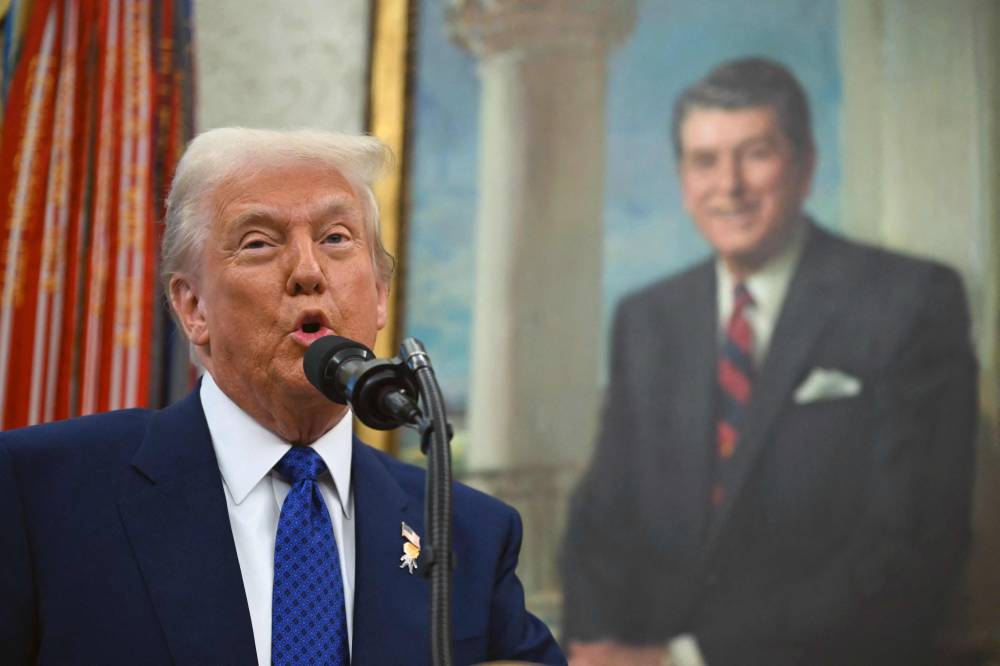
KUALA LUMPUR - US President Donald Trump's aggressive foreign and domestic policies in his second term appear to be a response to the belief that US hegemony is waning - an idea that has gained traction both in America and globally.
Professor Dr Johan Saravanamuttu, an adjunct professor at the Asia Europe Institute at Universiti Malaya, said this idea, central to Trump's "Make America Great Again" campaign, suggests that America has lost its global dominance and must reclaim it.
"China's growing competition is a key factor influencing Trump's approach. His first administration was characterised by efforts to limit China's rise, particularly in trade and technology.
"His second term appears to continue this trajectory, with policies aimed at countering China's growing economic and geopolitical influence,” Johan said as part of a panel at the BN Forum discussing ‘The Impact of Trump’s Policy’ at the World Trade Centre (WTC) here yesterday.
The forum, moderated by Higher Education Minister Datuk Seri Dr Zambry Abd Kadir, also featured three other panelists: Dr Elina Noor, Senior Fellow for the Asia Programme at the Carnegie Endowment for International Peace; Prof Dr Azmi Hassan, Senior Fellow at the Nusantara Academy of Strategic Research and Universiti Malaya Associate Professor Dr Khoo Yinh Hooi.
Johan, who is also a Professor Emeritus at Universiti Sains Malaysia said while America's military strength remains unparalleled, its ability to shape global events, particularly in the Indo-Pacific, has waned.
He said the rise of regional actors, including the Association of Southeast Asian Nations (ASEAN), has complicated the US's strategic calculations, adding that as Malaysia and other countries in the region assert themselves, it has become more difficult for the US to wield influence as it once did.
Meanwhile, Khoo compared Trump's leadership style to "bad Wi-Fi," highlighting its instability, unpredictability and disruptive impact on global affairs.
According to her, Trump's strategy is rooted in a business-oriented mindset, which, while effective in the corporate world, has unsettled international politics.
"Just like an unstable internet connection, his (Trump's) policies have been inconsistent, sometimes benefiting one country while straining relations with another. Furthermore, his interference in global affairs, much like a weak Wi-Fi signal disrupting daily activities, has raised economic and security concerns around the world,” she said.
Trump’s new administration has recently sparked global tensions following a series of aggressive policy announcements, including a proposal earlier this month to relocate approximately two million Palestinians from the Gaza Strip to neighbouring countries such as Egypt and Jordan.
Malaysia, a long-time supporter of Palestine, has strongly opposed the plan, calling it ethnic cleansing and a violation of international law and multiple UN resolutions. - BERNAMA
Download Sinar Daily application.Click Here!