The hidden dangers of religious cults threatening Muslim society
Experts warn that this trend can lead to the distortion of faith, social fragmentation, and the erosion of noble values.
NUR ADNIN MAHALIM

The hidden dangers of religious cults threatening Muslim society
Religious cults are increasingly seen as a threat to the Muslim community in Malaysia, as blind devotion to charismatic leaders and deviant teachings risk distorting faith, dividing society, and undermining true Islamic values.
The definition of a cult, as outlined in the Dewan Bahasa dan Pustaka Dictionary, refers to a system of worship in religious ceremonies.
Yet when tied to religion, it takes on a different meaning — a phenomenon where individuals or groups excessively revere leaders, teachings or organisations to the point of deviating from authentic religious principles.
In this regard, the verse of Allah SWT in Surah al-Ikhlas firmly declares that no one is worthy of worship except Allah SWT:
“Say (O Muhammad): He is Allah, the One. Allah, the Eternal Refuge. He neither begets nor is born. And there is none comparable to Him.”
Such cult phenomena have appeared across cultures and traditions, and the Muslim community is not immune to this influence. It often occurs when individuals or groups are excessively praised, treated as infallible, or even believed to possess extraordinary powers.
Experts warn that this trend can lead to the distortion of faith, social fragmentation, and the erosion of noble values.
Causes of religious cults

The emergence of religious cults is not sudden but the result of a long process of planting seeds of fanaticism.
A combination of social, psychological and religious factors plays a role in shaping this trend.
Among the main causes are:
1. Charismatic leaders – Leaders who claim spiritual superiority or secret knowledge often attract blind devotion from followers.
2. Lack of religious knowledge – Individuals with weak understanding of Islamic principles are more likely to accept deviant teachings.
3. Life pressures – Economic, social and political instability makes people vulnerable to cult influence.
4. Emotional manipulation and fear – Followers are controlled through threats and promises of doom should they leave the group.
5. Community isolation – Separating followers from the outside world ensures continued dependency on the cult.

Dangers of religious cults
a. Blind devotion to individuals : Followers view their leader as infallible and beyond question.
b. Deviation from Islamic teachings : Teachings introduced may contradict the principles of tawhid in Islam.
c. Exploitation of followers : In some cases, deviant leaders take advantage of followers financially, sexually, or through power abuse.
Deviant teachings
According to the Islamic Development Department (Jakim), more than 100 deviant teachings have been identified in Malaysia. These groups are often difficult to eradicate due to the excessive idolisation of leaders.
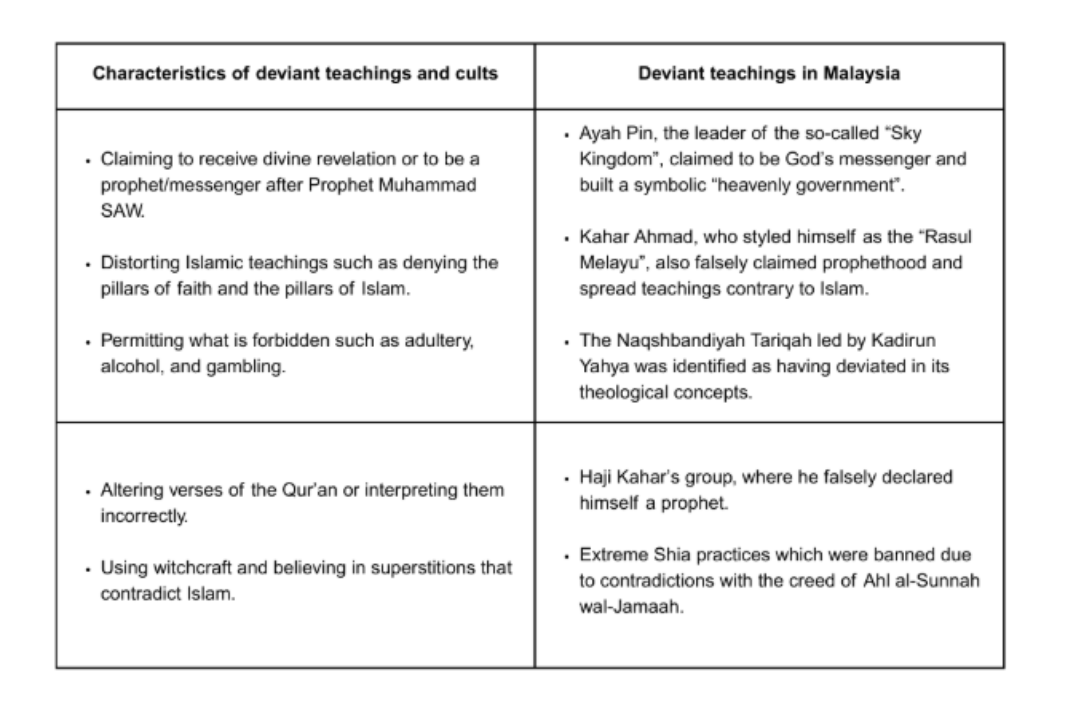
The difficulty in curbing deviant teachings and their re-emergence after enforcement actions lies in the element of cultism, where religious leaders are idolised excessively beyond the limits.
The solution to this problem is to eliminate the root cause, which is the cult mentality that glorifies religious leaders beyond what is taught in the Quran and Sunnah, ultimately making followers abandon reason and simply obey what is false and misguided.
In conclusion, religious cults and deviant teachings can threaten the harmony and stability of the Muslim community in Malaysia.
Therefore, it is vital for society to remain alert and firmly hold on to the Qur’an and Sunnah.
Download Sinar Daily application.Click Here!