What is Asperger's syndrome and how does it fuel Greta Thunberg’s activism?
Explaining why Greta Thunberg calls her Asperger's a 'superpower'


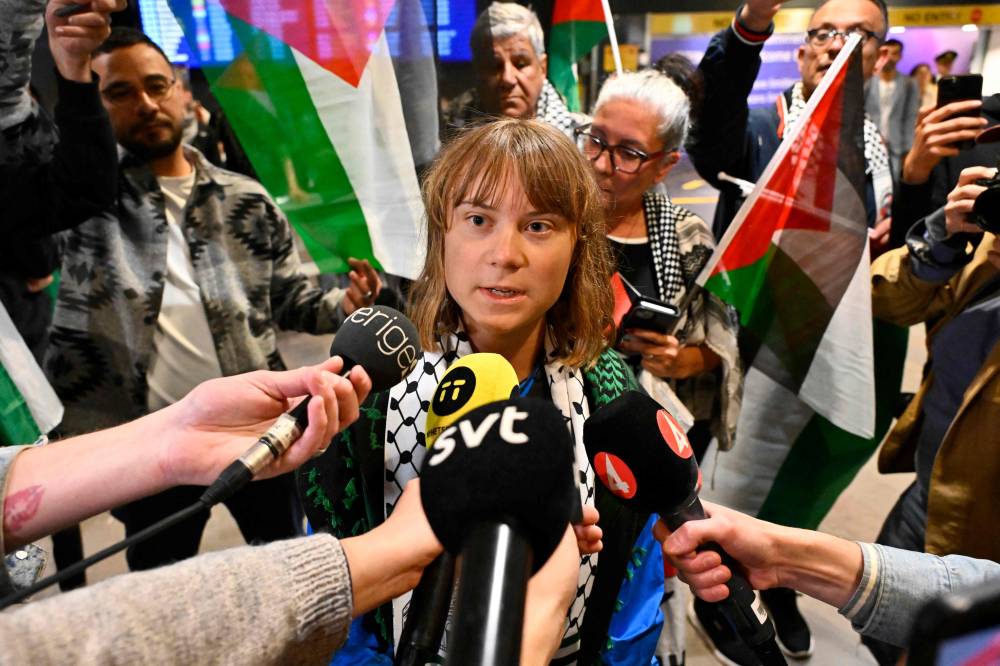
SHAH ALAM – Greta Thunberg’s detention by Israeli forces during the recent Global Sumud Flotilla (GSF) mission highlighted the 22-year-old Swedish activist’s resilience, which she credited to her neurodivergence.
Thunberg, who was diagnosed with Asperger’s syndrome, had often described her condition not as a limitation but as the driving force behind her courage, focus and refusal to conform.
But what exactly was Asperger’s and how had it shaped Thunberg’s activism and outlook on life?

What was Asperger’s syndrome?
Asperger’s was once a separate medical diagnosis used to describe individuals who exhibited characteristics of autism but typically possessed average or above-average intelligence and no significant delay in speech.
Before 2013, the term was widely used by doctors and psychologists.
However, that year, the American Psychiatric Association (APA) released the fifth edition of the Diagnostic and Statistical Manual of Mental Disorders (DSM-5), which reclassified Asperger’s under the broader umbrella of Autism Spectrum Disorder (ASD).
This change was made to reflect the understanding that autism existed on a spectrum: a continuum of traits and abilities rather than as separate, distinct conditions.
Today, people who would have once been diagnosed with Asperger’s are now described as having ASD Level 1, meaning they require relatively low levels of support in daily life. While Asperger’s is no longer an official medical diagnosis, many still proudly identify with the term and consider it part of their personal identity.
Common characteristics and strengths
Individuals with an Asperger’s profile often shared certain traits; some challenging, others uniquely powerful.
- Social communication: They struggled with nonverbal cues such as facial expressions or eye contact, found small talk difficult, or spoke at length about a favorite subject.
- Repetitive behaviours and routines: Many preferred structure, had highly focused interests, and could become distressed by sudden change.
- Sensory sensitivity: Bright lights, loud noises, or specific textures could be overwhelming.
- Cognitive abilities: Unlike other forms of autism, individuals with Asperger’s typically showed average or above-average intelligence, with strong verbal and analytical skills.
- Associated challenges: Anxiety, depression and difficulties with coordination were common but manageable with support.
Despite the challenges, many described their Asperger’s as a source of clarity, focus and passion; qualities Thunberg had publicly embraced.
Thunberg on living with Asperger’s
Thunberg had never hidden her diagnosis. Instead, she reframed it as an integral part of who she was. In 2019, she addressed online critics directly.
“When haters go after your looks and differences, it means they have nowhere left to go. And then you know you are winning! I have Asperger’s syndrome and that means I am sometimes a bit different from the norm. And given the right circumstances, being different is a superpower,” she said.

Thunberg described that she went public with her diagnosis not to use it as an excuse, but to educate others and challenge misconceptions.
“I am not public about my diagnosis to ‘hide’ behind it, but because I know many ignorant people still see it as an ‘illness’ or something negative. Before I started school striking, I had no energy, no friends, and I did not speak to anyone.
"I just sat alone at home, with an eating disorder. All of that is gone now, since I have found a meaning, in a world that sometimes seems meaningless to so many people,” she added.
Her words had since inspired countless neurodivergent individuals who saw in her the power of difference, the ability to focus intensely on truth and justice, even when it meant standing alone.
Why the term “Asperger’s” was controversial
While many continued to use the word “Asperger’s,” the name had drawn controversy because it was originally coined after Hans Asperger, an Austrian pediatrician later linked to Nazi eugenics programmes.
As a result, some autistic advocates preferred the term Autism Spectrum Disorder (ASD) to avoid historical associations.
However, the most respectful approach was to use the terminology a person preferred, whether ‘autistic,’ ‘Asperger’s,’ or ‘aspie.’
How Asperger’s had shaped Thunberg’s activism
Thunberg’s unwavering dedication to climate justice and, more recently, humanitarian causes like GSF, reflected her neurodivergent focus and moral conviction.
Her ability to block out distractions and stay intensely committed to a cause was a hallmark of what she once called her “superpower.”
It was the same focus that had helped her mobilise millions around the world for climate strikes and humanitarian advocacy.
Thunberg’s detention and the Global Sumud Flotilla
In early October, international outrage erupted after Israeli forces intercepted the GSF, a 45-ship humanitarian convoy carrying over 450 volunteers from 47 nations on a mission to break Israel’s blockade of Gaza.
Between Oct 1 and Oct 3, Israeli naval units seized several vessels, detaining hundreds, including Thunberg.
Witnesses later alleged that detainees were beaten, zip-tied, deprived of food and medicine, and forced to drink from toilets.
Some claimed Thunberg herself was “dragged on the ground” and “paraded like a trophy.”
Israel’s Foreign Ministry dismissed these claims as “complete lies,” while National Security Minister Itamar Ben-Gvir said he was “proud” of how the activists were treated, calling them “supporters of terrorism.”
Thunberg and more than 70 detainees were released from Israeli custody on Oct 6 and flown to Greece before returning home.
However, 28 Spanish nationals reportedly remained imprisoned.
Meanwhile, global protests erupted in cities including Rome, Amsterdam, Barcelona, London, Lahore, Istanbul and Kuala Lumpur, with millions condemning Israel’s actions and describing the flotilla raid as part of a “genocide against Palestinians.”
Several Malaysian activists including Heliza Helmi, Hazwani Helmi, Zizi Kirana and Farah Lee were among those detained but released and flown to Istanbul on Oct 5, following coordinated efforts involving Turkiye, Qatar, Egypt, Jordan and the United States (US).
By Oct 6, the flotilla’s interception had reignited global debate over Israel’s blockade of Gaza, widely condemned as a violation of international law and collective punishment.
Why Thunberg’s story mattered
Thunberg’s activism could not be separated from her identity as a neurodivergent individual who saw the world differently and acted on it.
Her journey from a quiet, isolated teenager to one of the world’s most recognizable activists illustrated how embracing difference could transform both individual lives and global movements.
Download Sinar Daily application.Click Here!


