This is Lim Guan Eng’s letter to PM that outlines 10 points to regain public confidence
IN case you missed it, last week the DAP advisor presented ten demands that he considers crucial national matters to Prime Minister Datuk Seri Anwar Ibrahim.
SINAR DAILY REPORTER
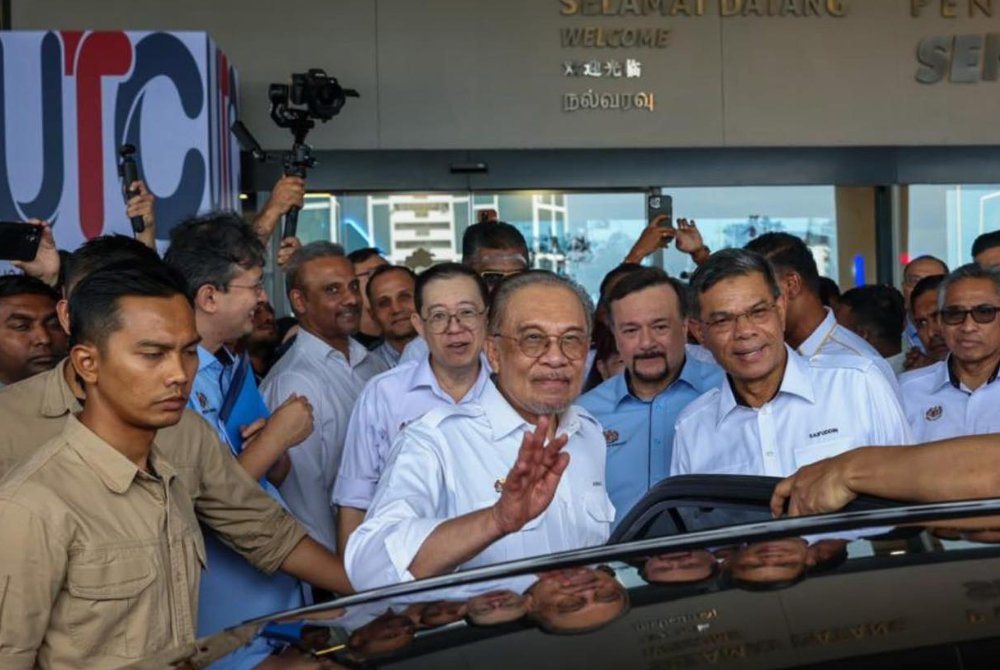
IN case you missed it, last week DAP advisor Lim Guan Eng presented ten demands that he considers crucial national matters to Prime Minister Datuk Seri Anwar Ibrahim.
In a five-page letter addressed to Anwar, the Bagan MP and former Finance Minister titled his submission: 'Fulfilling the Promise to Defend the Rights of Pakatan Harapan (PH) Supporters, Sabah and Sarawak, and Immediately Implementing the PH 15th General Election (GE15) Manifesto Promises.'
"With all due respect, I refer to the above matter and apologise for my absence from the PH Presidential Council meeting this week.
"There is currently a crisis of confidence in the government among PH supporters, which can only be restored through the enactment of new government policies that safeguard their interests without undermining the benefits of any other Malaysian group,” he wrote.
In the list of 10 key points, Lim Guan Eng first emphasised that the PH GE15 manifesto promises must be fulfilled. He stressed that as trustees of the voters, there is no other choice but to immediately implement the PH Manifesto promises.
This was followed by a recommendation for the government to channel a 10 per cent allocation to non-Bumiputera groups compared to the Bumiputera allocation, without reducing the existing provisions for Bumiputera.
"There is dissatisfaction that the non-Bumiputera allocation has not been increased but has instead decreased compared to the previous government, particularly in the education and economic sectors.
"There is no objection from the non-Bumiputera community regarding what is allocated to the Bumiputera group, but the current grant of three per cent to non-Bumiputera compared to the total allocated to the Bumiputera group in the budget or the 12th Malaysia Plan (RMK12) is too small,” the letter said.
For the third point, Lim urged the government to review the expansion of the Sales and Services Tax (SST) scope on Malaysian businesses.
He reasoned that the role of Small and Medium Enterprises (SMEs) cannot be denied, as they contribute 38 per cent to the Gross Domestic Product (GDP), a figure targeted to rise to 40 per cent by 2030 and generate 48 per cent of national employment and nearly 13 per cent of Malaysia's total exports.
He further recommended that the government mandate the purchase of 50 per cent of essential goods from local producers, in addition to imposing a 10 per cent SST on imported and local iron ore, metallurgical coking coal and coke, while simultaneously abolishing SST on scrap iron to protect local industries.
For the fifth point, Lim recommended the government allocate RM20 billion for outstanding tax refunds by January 2026.
He deemed the decision to increase the allocation for outstanding tax repayments from RM2 billion to RM4 billion insufficient, given that the backlog of tax repayments amounts to tens of billions of ringgit.
He then suggested freezing the two per cent Employees Provident Fund (EPF) contributions for foreign workers and their employers, which he views as burdensome.
Furthermore, he proposed not imposing the two per cent tax on dividend income exceeding RM100,000 for non-listed companies on Bursa Malaysia or partnership businesses.
The seventh recommendation calls for the abolition of the RM10,000 penalty under Section 45F of the Employment Insurance System (EIS) Amendment Bill in the Senate, which is currently imposed on employers who fail to notify the Social Security Organisation (SOCSO) of any job vacancies or new positions.
Lim also recommended that the 40 per cent revenue demand from Sabah must be resolved promptly and that the rights of Sarawak must continue to be safeguarded, noting that the Sabah revenue claim issue was a major factor in the recent state election.
He stressed that the issue must be resolved and the money repaid quickly so that it is not seen as being deliberately delayed by the Federal Government.
The ninth point calls for the government to study the exemption of SMEs from e-invoicing while raising the annual business revenue threshold to RM5 million.
"While the study is being conducted, a temporary measure is to raise the annual business revenue threshold to RM5 million.
“This must be expedited as the e-invoicing regulation will be enforced for businesses with annual revenue between RM1 million to RM5 million starting January 1, 2026," he stated.
The final suggestion is the establishment of a tribunal for individual and SME taxpayers, similar to the consumer tribunal, to ensure fairness for all parties.
"Individual taxpayers and SMEs often complain that they are pressured by unreasonable tax assessments by the Inland Revenue Board (LHDN). They feel powerless because they cannot afford to fight LHDN due to the high legal costs.
"While LHDN's efforts to increase revenue for the country are appreciated, it must also be balanced with reasonable action so that bank accounts are not frozen arbitrarily," he concluded.
The public nature of Lim’s demands immediately drew criticism from within the PH coalition, with leaders suggesting the move was counterproductive and damaging to the ruling Unity Government’s image.
Amanah Youth chief Mohd Hasbie Muda stated that such "attacking statements" and open demands only serve to complicate matters and tarnish the government’s image.
He said as a member of the PH Presidential Council, Lim should have exercised proper channels by bringing his 10 points up during the council’s internal meetings, noting that Anwar is known to be "very open and diligent in listening to views and criticisms" during these sessions.
Meanwhile, PKR's Pasir Gudang MP Hassan Abdul Karim questioned the fairness of the pressure being applied by DAP, particularly in light of an earlier statement by DAP Secretary-General Anthony Loke suggesting the party might reassess its role if meaningful reforms were not carried out within six months.
Hassan strongly characterised the ultimatum as a form of threat, asserting that any failure to fulfill the manifesto should be considered a collective failure shared by all component parties.
He also stressed that DAP should demonstrate gratitude for their current positions in government, reminding the party that they have been part of the administration for three years, with five key leaders serving as ministers and many others appointed as deputy ministers.
However, Hassan acknowledged the severe political instability that would ensue should DAP choose to withdraw from the current government.
He conceded that such an action would carry a "strong possibility" of collapsing Anwar's administration, but warned that DAP would then have to "bear the risk of being condemned by the public indefinitely" for causing the instability.
Download Sinar Daily application.Click Here!