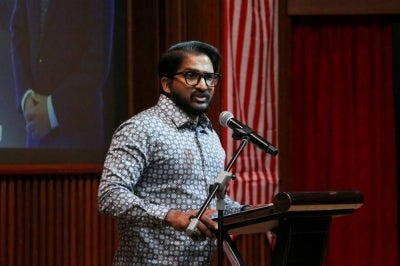
Once suspended under AUKU, Adam Adli now helps shape it
More than a decade on, he sees that journey not as a departure from his past, but an extension of it.



SHAH ALAM — Education Deputy Minister Adam Adli Abd Halim now operates within the very system that once pushed him to its margins — having been suspended under the Universities and University Colleges Act (AUKU), he now helps interpret and administer it.
More than a decade on, he sees that journey not as a departure from his past, but an extension of it.
"It feels almost poetic to now be in a position where I help administer the very Act under which I was once suspended," he told Sinar Daily.
For Adam, activism and governance are not opposing forces, but part of the same continuum.
His years as a student activist, he said, remain a working strength, shaping how he understands policy beyond paper.
"More than a decade later, I have been entrusted with the responsibility to help shape better policies for students and I see that as meaningful. I treat my experience as a student activist as a strength," he said.
At the same time, he is mindful of the risks that come with perspective and the need to evolve beyond it.
He said while his background in activism came with certain biases, he was conscious of that.
"My role now is to learn, evolve and ensure that I make decisions that are fair and balanced for all stakeholders within the higher education sector," he said.
That shift is most evident in moments that mirror his past as he now receives student memorandums in Parliament instead of delivering them.
"When I receive memorandums from students protesting at Parliament now, the first thing that comes to mind is, ‘So this is how it feels.’ I used to be on the other side handing over those memorandums, so it’s a full-circle moment," he added.
But he resists framing it as nostalgia. To him, it is a test of leadership, not symbolism.
"There is always a temptation in politics to avoid criticism, but that would be a mistake.
"When students come forward with their demands, it is our duty to listen," he said.
He acknowledged that criticism can be sharp, even personal but insists it comes with the role.
"It may not always be comfortable and sometimes the criticism can be harsh, even personal. But if we are not prepared to be criticised, even humiliated at times, then we should not be in this position," he said.
Leadership in higher education, he argued, cannot be insulated.
It demands direct engagement with voices that are often inconvenient or uncomfortable.
On whether his activist past clashes with his role in government, Adam is unequivocal—it does not.
Instead, he sees it as a perspective that strengthens governance.
"I don’t see it as a conflict. In fact, I see it as something positive. My activist background gives me a different perspective, and that perspective helps in governance," he said.
Within the ministry, he points to a deliberate balance.
Working alongside Higher Education Minister Datuk Seri Zambry Abdul Kadir, whose strengths lie in academia and administration, Adam sees their differing backgrounds as complementary.
"The minister is from academia, I’m from activism — that contrast creates synergy," he said, calling it a balance that bridges institutions with student realities to find better solutions.
Download Sinar Daily application.Click Here!