Anwar's popularity has declined significantly, says Abdul Kadir
National Journalism Laureate attributes the decline to alleged nepotism, sidelining of original Reformasi figures and shifting Malay political support


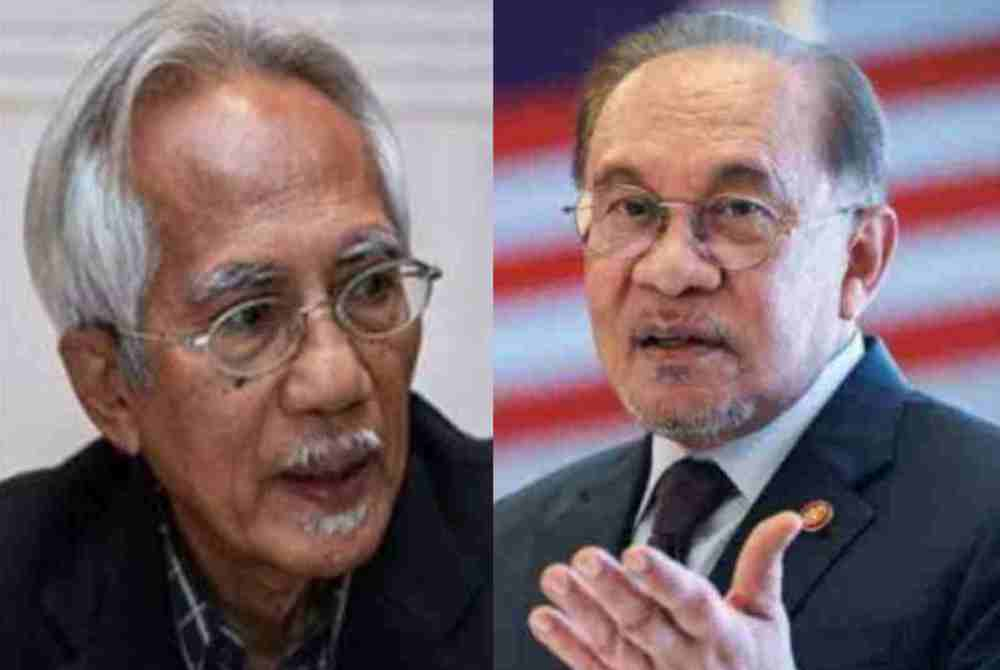
SHAH ALAM – The decline in Datuk Seri Anwar Ibrahim's popularity is extraordinary for a leader who waited so long and worked so hard to become Prime Minister, says National Journalism Laureate Datuk Abdul Kadir Jasin.
He said the situation stemmed from alleged nepotism and a failure to recognise the contributions of those involved in the original Reformasi movement, resulting in divisions within Parti Keadilan Rakyat (PKR).
"He is seen as giving priority to his own daughter, Nurul Izzah, as well as new associates such as Ramanan Ramakrishnan," he said in a statement on Monday.
Abdul Kadir said the continued decline in support for Pakatan Harapan (PH), particularly PKR and Amanah, was also reflected in the results of the Melaka State Election on November 14.
He said Anwar had failed to strengthen PKR's leadership and voter support.
"In the Melaka State Election, PH contested 28 seats but won only four, all of which went to DAP.
"Barisan Nasional (BN) won 21 seats, while Perikatan Nasional (PN) secured three," he said.
Abdul Kadir said BN's landslide victory and PH's heavy defeat in the election came as no surprise.
He said Umno, as BN's main component party, had a strong support base in the southern states of Peninsular Malaysia, while PH had secured a majority victory only once, in the 2018 General Election under the leadership of Tun Dr Mahathir Mohamad.
In the 2022 General Election, PH, under Anwar's leadership, won only 82 of the 222 Dewan Rakyat seats.
Abdul Kadir said Anwar had only managed to form the government and become Prime Minister with BN's participation, while Umno president Datuk Seri Dr Ahmad Zahid Hamidi realised that the party would face serious consequences if it lost power.
He said Pas had triggered a "green wave" following the 2022 General Election and the six state elections in 2023, resulting in heavy defeats for PH-BN.
"Umno began to realise that its alliance with its long-time rival, DAP, was not well received by the Malays," he said.
However, Abdul Kadir said Malay support for Umno began to recover after the party started criticising DAP and distancing itself from PH, beginning in its stronghold of Johor, followed by Negeri Sembilan and Melaka.
Nevertheless, he said victories in the three states did not guarantee that Umno could regain its influence in the northern and east coast states.
This was because Pas and its allies were unlikely to give up the seats they had won in those states for Umno to contest, while Umno had almost disappeared from the political landscape in those areas.
Abdul Kadir also said BN and PN appeared to be cooperating, an arrangement that had attracted some Malay voters.
He said the cooperation was viewed favourably by Malays who opposed PH, as they saw it as an understanding between Umno and Pas to bring down the coalition.
"Pas, which is now the largest party in Parliament, strongly dislikes PH because the coalition includes Amanah, or Parti Amanah Negara, which broke away from Pas," he said.
He added that Pas also opposed PH because of the coalition's support for Anwar and its opposition to Dr Mahathir.
Abdul Kadir said Pas's participation in Pakatan Rakyat (PR), before its eventual dissolution, had ultimately worked against the party's interests.
According to him, Pas lost support among Malays because of its close ties with DAP, while Umno quickly realised that its cooperation with DAP through PH in the Madani Government was unpopular among its supporters.
Abdul Kadir said Pas and Umno were currently working together to bring down PH, but what would happen after achieving that goal remained uncertain.
"It is not impossible that Pas and Umno could end up fighting each other again," he said.
He said Pas was aware that Umno was no longer as strong as it once was and that its leadership was not what it used to be.
He added that Pas could also face accusations of aligning itself with a party responsible for significant damage if it continued cooperating with Umno.
Abdul Kadir also questioned whether it would make sense for Pas to hand the Prime Minister's post to Umno, given that Pas held more seats in Parliament.
He added that although Pas was not infallible, its leadership was perceived as having greater integrity than Umno's.
Download Sinar Daily application.Click Here!