Why Malaysia's leadership was key to bringing Thailand and Cambodia to the table
Malaysia’s diplomatic credibility, strengthened under Anwar’s leadership, played a central role in brokering a ceasefire between Thailand and Cambodia after days of deadly conflict.


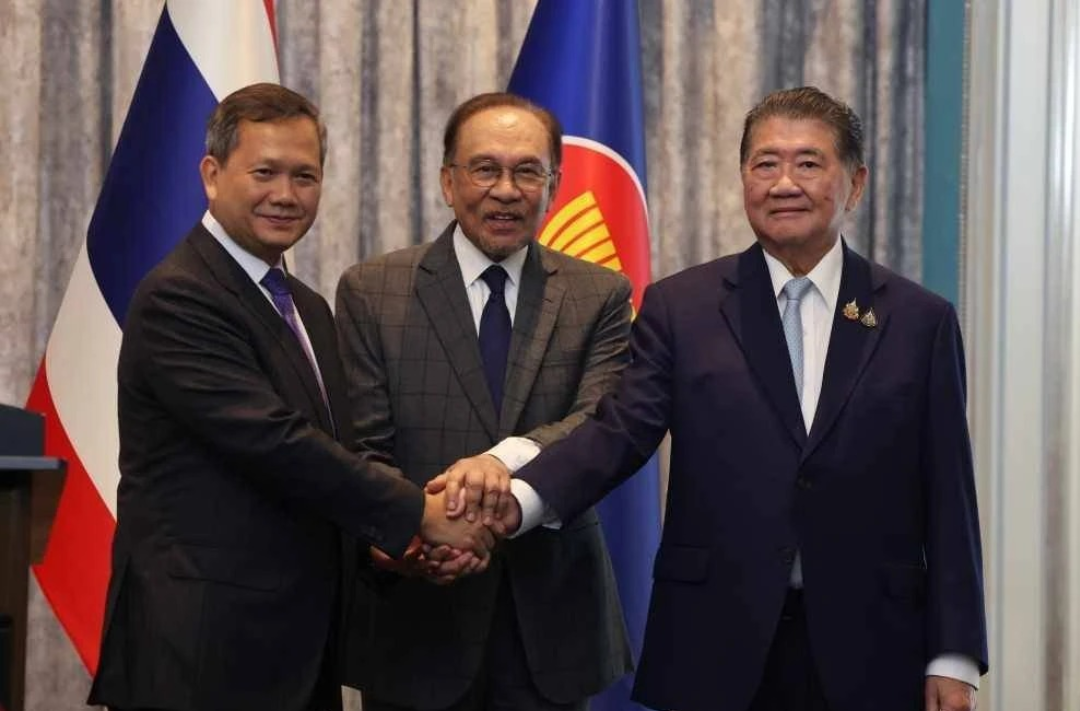
SHAH ALAM – Prime Minister Datuk Seri Anwar Ibrahim’s charismatic and personable nature was instrumental in fostering smoother engagement with Thai and Cambodian leaders, which helped advance a ceasefire through regional leadership.
This is according to the National Defence University of Malaysia’s Centre for Defence and International Security Studies Director Professor Dr Adam Leong Kok Wey.
"As the current ASEAN Chair and a respected regional middle power known for its diplomatic approach to security challenges, Malaysia is working through the ASEAN Centrality framework to help resolve a regional crisis,” Leong told Sinar Daily when contacted.
He stated that Asean members have also signed the Treaty of Amity and Cooperation in Southeast Asia (TAC), which embodies the principles of peaceful coexistence and friendly cooperation among member states.
Malaysia’s diplomatic credibility, strengthened under Anwar’s leadership, played a central role in brokering a ceasefire between Thailand and Cambodia after days of deadly conflict.
Over 30 lives were lost and nearly 200,000 people were displaced when violence erupted along the long-disputed 817-kilometre border.
Tensions had reached a breaking point following clashes in Cambodia’s Preah Vihear region, triggering fears of a wider regional escalation.
Malaysia stepped in as mediator during this critical moment, successfully facilitating face-to-face talks in Kuala Lumpur between Cambodian Prime Minister Hun Manet and Thailand’s Acting Prime Minister Phumtham Wechayachai.
The outcome was an immediate and unconditional ceasefire.
To this, Leong claimed that Malaysia has substantial experience in peacekeeping and conflict mediation, having played critical roles in Mindanao and Timor Leste, alongside broader contributions to United Nations (UN) peacekeeping missions.
He said that Malaysia’s involvement in UN peacekeeping operations has received accolades for its professionalism and devotion to upholding the UN’s collective security norm.
He said any deployment would require consent from both Thailand and Cambodia.
While the ceasefire is largely holding, he said that minor unverified breaches may stem from frontline miscommunication, which is common in such situations. No major escalation has been reported.
The ceasefire agreement was sealed in a special meeting chaired by Anwar at the Seri Perdana Complex.
Also present were United States (US) Ambassador to Malaysia Edgard Kagan, who co-organised the session and Chinese Ambassador Ouyang Yujing, who attended as an observer.
Their presence highlights Malaysia’s ability to navigate global interests while keeping Asean in the driver’s seat.
Anwar later announced key follow-up steps, including coordinated regional military meetings, resumed high-level communications between both nations and the reactivation of the General Border Committee (GBC) in early August, hosted by Cambodia.
A Strategic Diplomatic Role
Universiti Tunku Abdul Rahman political science and international relations lecturer Afi Rozhesry described Anwar’s recent diplomatic efforts as a reflection of his strategic leadership and principled diplomacy. He stated that Anwar’s roles, especially ahead of Malaysia’s Asean chairmanship in 2025, demonstrate his ability to navigate complex regional and global dynamics with coordination, consistency and credibility.
In the context of ASEAN, Afi said Anwar has emphasised unity in negotiations, consistently working to ensure that member states speak with one voice.
He led efforts to ensure that any bilateral tariff agreements with the US do not harm other Asean economies, personally consulting with leaders in Thailand, Indonesia, the Philippines and Singapore to develop a joint response to the proposed US reciprocal tariffs.
Afi pointed out that Anwar has consistently promoted rules-based multilateralism, favouring World Trade Organisation (WTO) mechanisms over unilateral approaches.
He also said that Anwar's commitment to keeping Asean open, non-aligned and principled is clear, as he firmly defends national policies like the Bumiputera agenda during trade talks without straining diplomatic ties.
Anwar has also strengthened engagement with major global partners including the US, China, India and Brazil, while actively pursuing economic diversification.
In 2025, Afi said Anwar played a key role in regional peace efforts and economic initiatives, including Asean-Gulf Cooperation Council (GCC) cooperation and the launch of Asean-India Free Trade Agreement (FTA) talks.
Afi said Anwar has hosted high-level delegations, such as from Germany, to reignite Malaysia-European Union (EU) FTA negotiations.
This is part of a broader strategy that includes leveraging relationships with BRICS nations and promoting UN-linked investment opportunities for Malaysian companies.
Afi stated that Anwar’s extensive experience in diplomacy and negotiations clearly demonstrates why he has been entrusted with such roles and he has capability and credibility on the international stage.
Southern Thailand Mediation
He also pointed out that Anwar's involvement as a mediator does not necessarily signal a concession to external influence, particularly from the US.
It can reflect a strategic positioning within both regional and global diplomatic frameworks.
“Malaysia has long pursued an independent foreign policy, often defined by non-alignment and constructive engagement.
Anwar’s mediation efforts can be seen as consistent with these principles, supporting peace and regional stability without yielding to pressure from major powers,” he said.
Similarly, Afi said that the Anwar mediation reflects a proactive effort by Malaysia to assert agency in shaping outcomes, rather than allowing major powers to dominate the narrative.
He said Anwar's framework can position Malaysia as a credible neutral actor in complex disputes, backed by domestic support and strategic diplomacy, thereby enhancing the country's diplomatic capital within Asean and beyond.
He viewed the mediation as a response to rising external pressure, particularly from the US, but interpreted it as a strategic assertion of leadership and autonomy, not a concession to foreign influence.
Afi said that Malaysia’s selection as a mediator in the southern Thailand peace process highlights growing regional trust and reflects its evolving role as a capable diplomatic player.
“We need to understand that Malaysia shares a long land border with southern Thailand, particularly with conflict-affected provinces like Pattani, Yala and Narathiwat, which are home to a significant number of Malay Muslims.
"As you know, Malaysia has strong ties with these communities, some even have family members here,” he said.
Afi stated that Malaysia’s shared border and cultural ties with southern Thailand give it a unique advantage as a mediator.
Its Muslim-majority identity allows it to be seen as a neutral yet culturally sympathetic actor by insurgent groups, helping to build trust and open communication channels.
He stated that Malaysia’s history of discreet, facilitative diplomacy in regional conflicts aligns with Asean norms and reflects growing regional trust.
Deploying observers or reconnaissance teams, he said, allows Malaysia to gather reliable on-the-ground intelligence, enhance informal diplomacy, and demonstrate active engagement.
However, he cautioned that such deployments carry risks and must be guided by clear mandates, strong safety protocols, and maintained neutrality to avoid unintended consequences.
“The government must also make sure to ensure the weight of operational risks and to ensure robust safety protocols and always maintain diplomatic neutrality to avoid unintended consequences because we do not know anything can happen,” he said.
Regional Trust and Credibility
Supporting this view, Nusantara Academy of Strategic Research (NASR) geostrategist Professor Dr Azmi Hassan praised Malaysia’s consistent and effective mediation record, describing Malaysia as a highly effective mediator.
He cited Malaysia’s neutral role in the southern Thailand peace process and in facilitating the Bangsamoro peace agreement in southern Philippines.
Azmi said that Malaysia’s approach, while inclusive of superpowers like the US and China, remains firmly anchored in Asean’s own interests and leadership.
“Malaysia isn’t conceding power, it’s using diplomacy to ensure that Asean leads, with external powers supporting rather than dominating,” he said.
At the joint press conference, Anwar reiterated Malaysia’s commitment to regional peace.
He confirmed both parties’ readiness to de-escalate tensions, establish direct communication channels and maintain ceasefire efforts under Asean guidance.
Anwar’s leadership throughout the crisis has been widely acknowledged, not only for calming a potential regional flashpoint but also for positioning Asean as a unified, credible force in global diplomacy.
This ceasefire marks a testament to the effectiveness of regional negotiation, the quiet power of diplomacy and Malaysia’s evolving role as a trusted peacemaker in Southeast Asia.
Download Sinar Daily application.Click Here!


