Clearer guidance needed on lawyers’ social media conduct - CMCF
“Debate is healthy; turning court files into rage-bait isn’t, especially when a child is involved," says CMCF CEO



SHAH ALAM – Rather than imposing stricter social media rules on lawyers, clearer practice guidance, continuous education and consistent enforcement may offer a more effective way forward in managing online commentary about court cases.
Addressing calls for stricter social media regulations for lawyers, Communications and Multimedia Content Forum of Malaysia chief executive officer Mediha Mahmood said existing frameworks already have provided adequate safeguards.
These, she said included legal provisions, court directions, Malaysian Bar guidance, social media platform rules and the Content Code.
“What may help more are clearer practice notes, steady professional education and above all, consistent enforcement,” she told Sinar Daily, today.
Mediha said while healthy public discourse around court judgments is a cornerstone of democracy, problems arise when commentary becomes sensational, misleading, or undermines confidence in the judiciary.
“Debate is healthy; turning court files into rage-bait isn’t, especially when a child is involved. Protect children, respect the court. Social media may be powerful; but it isn’t an appeals court,” she said.
This comes amid growing public concern over the role of lawyers on social platforms, particularly following viral posts from legal professionals commenting on ongoing or sensitive legal matters, including cases involving minors.
Mediha emphasised that publishing court documents or transcripts, even after a case concluded, must be done with respect to court directions and confidentiality obligations.
She said the line was especially clear when children were involved.
"Nothing should be posted that could directly or indirectly identify them (children)," she said.
She noted that while it was acceptable to debate judgments in good faith, problems arise when online commentary suggested impropriety, misled the public, or undermined trust in the courts.
The tone and context matter, she added.
Recently, lawyer and influencer Tun Laila drew controversy on TikTok after defending her role in a high-profile abuse case involving a teenage Down syndrome girl, Bella.
In a lengthy social media statement, she shared personal observations from the courtroom and published transcripts and court documents, sparking public outrage and debate over professional boundaries.
On the issue of contempt, Mediha stressed that the law applied equally online and offline.
She said posts that risked undermining the administration of justice or scandalising the court could amount to contempt.
“Fair, reasoned critique is one thing; accusations and insinuations are another,” she said.
She said for legal professionals, the consequences could be serious.
Depending on the context, she said misconduct may lead to contempt proceedings in court, as well as disciplinary action by the Malaysian Bar Disciplinary Board.
She also highlighted that professionals with significant online followings carried added responsibility.
The Content Code outlined ethical standards such as accuracy, sensitivity and avoiding content that retraumatises or invites harassment, principles that apply to viral videos just as they do to mainstream news stories, she said.
Meanwhile, commenting on the matter, former Malaysian Bar president Salim Bashir echoed these concerns, warning that lawyers must exercise caution when sharing court documents or evidence online.
“Posting materials or evidence not publicly available may jeopardise the fairness of a trial or be seen as compromising the administration of justice,” he said when contacted.
He warned that such disclosures could distort witness testimonies and create prejudicial effects, particularly in ongoing trials or appeals.
Citing PP v Datuk Seri Najib Razak [2020] MLR 1064, he referenced judge Datuk Mohd Nazlan Mohd Ghazali's observation that uploading court proceedings online without permission may amount to contempt of court.
Salim also stressed the importance of protecting the confidentiality of court proceedings and the emotional wellbeing of witnesses, noting that careless disclosures may cause unnecessary anxiety.
“Ultimately, it is crucial for all parties to uphold and protect the fundamental right to a fair trial,” he added.
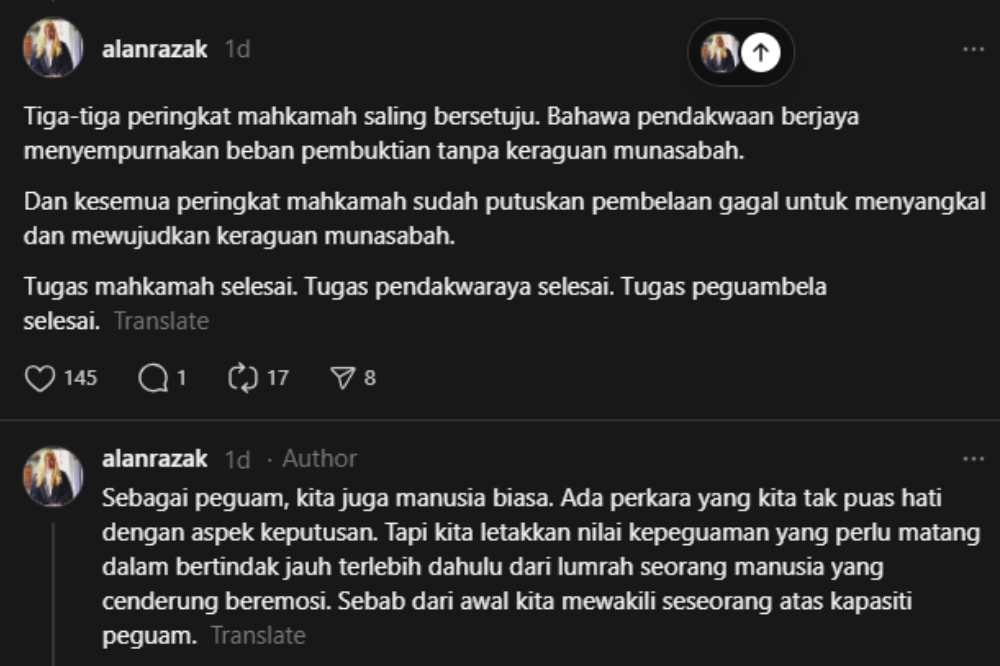
On the Threads platform, lawyer Azlan Abdul Razak from Messrs. Azlan Razak & Associates also commented on the issue, emphasising that in the case, justice has been heard at all three levels which were in the trial, appeal and final appeal.
He stressed that prosecutors would not proceed without sufficient evidence, as the burden of proof in criminal cases was high, beyond reasonable doubt.
“As lawyers, we are human too. There are times we may disagree with the outcome. But our professional judgment must come before personal emotions, because from the start, we act in our capacity as legal counsel,” he wrote.
Azlan cautioned against expressing dissatisfaction by accusing the judicial system of being flawed simply because a client lost a case. Instead, he urged legal professionals to examine the legal issues and facts decided by the court and engage in respectful, informed discourse.
He reminded that lawyers were called to argue in court and should use discretion when explaining cases to the public, to inform, not to create alternative narratives.
“Narratives are tested in court. And in this case, the court found the proposed narrative unsupported by the evidence.
“A lawyer is a lawyer, not a publicist and certainly not a lobbyist,” he added.
Meanwhile, lawyer Fatihah Jamhari said the online sharing of court video recordings may amount to contempt of court as it risked undermining justice and bringing disrepute to the judiciary.
She noted that while Rule 9 of the Legal Profession (Practice and Etiquette) Rules 1978 supported fair representation, it must be exercised with honour. She said in her view, Tun Laila’s actions fell short of this standard and violate Rule 15, which required respect for the courts.
“If a report is lodged with the Advocates and Solicitors Disciplinary Board and an inquiry is opened, her Practising Certificate could be at risk,” she added.
Tun Laila became the centre of online attention after posting a video defending her involvement in the abuse trial of Rumah Bonda founder Siti Bainun Ahd Razali, who was convicted of abusing and neglecting Bella.
Despite facing widespread criticism, she maintained she was not defending abuse but advocating for what she believed to be a misrepresented case. In the video, she pointed to inconsistencies in witness testimony and the lack of medical evidence for many allegations.
In her video, she quoted religious texts and published excerpts from court documents and personal diaries of those involved, urging her followers to seek the truth with open hearts.
On Aug 14, the Court of Appeal upheld a 12-year prison sentence against Siti Bainun for neglecting and abusing Bella, four years ago.
A three-member panel, comprising Justices Datuk Azman Abdullah, Datuk Azmi Ariffin and Datuk Hayatul Akmal Abdul Aziz, dismissed the 33-year-old’s final appeal against the conviction and jail sentence handed down by the Kuala Lumpur Sessions Court on May 3, 2023.
Sessions Court Judge Izralizam Sanusi sentenced Siti Bainun to 12 years in prison after finding her guilty of two counts of neglecting and abusing 13-year-old Bella.
Siti Bainun was charged with neglect and abuse causing physical and emotional injury to the victim at a condominium unit in Wangsa Maju between February and June 2021, under Section 31(1)(a) of the Child Act 2001, which carries a maximum sentence of 20 years imprisonment, a fine of RM50,000, or both.
Delivering the unanimous decision, Justice Azman said the court found no errors of fact or law in the High Court judge's findings, which had been based on the detailed conclusions of the Sessions Court judge.
Download Sinar Daily application.Click Here!