Selangor, Terengganu lag as voter numbers far outstrip parliamentary seats
KHAIRIL ANWAR MOHD AMIN IZWAN ROZLIN
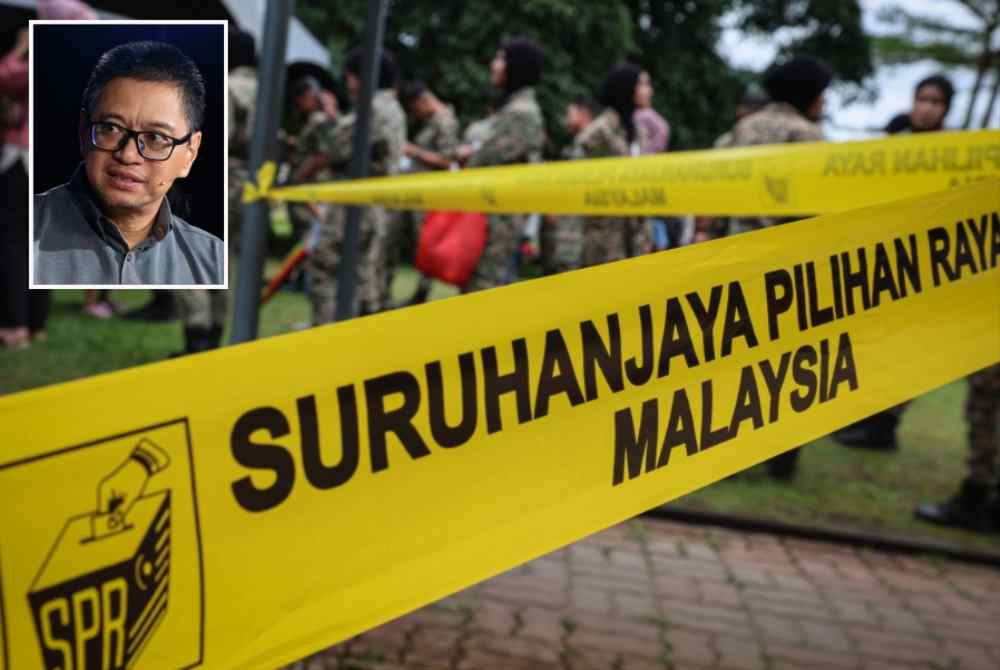
KUALA LUMPUR – Selangor and Terengganu have been identified as states with disproportionately low parliamentary representation despite having large numbers of voters, while Sabah and Sarawak are regarded as overrepresented, according to the Election Commission (EC).
EC deputy chairman Dr Azmi Sharom said the situation remained consistent with the Federal Constitution, which does not prescribe a fixed number of parliamentary or state legislative assembly (DUN) seats but instead emphasised that constituency sizes within a state should be roughly equal.
"If we refer to the Federal Constitution, there is no specific appropriate number given. We should try our best to determine that the size of each constituency in every state is roughly the same," he said.
During a special interview with Sinar, Azmi said geographical and demographic realities, particularly in vast rural areas with small populations, must be taken into consideration, adding that differences in constituency size should not be excessive.
He also said there was a need for clearer redelineation guidelines, although the EC must continue operating within the existing legal framework.
In the current setting, Selangor and Terengganu were considered underrepresented.
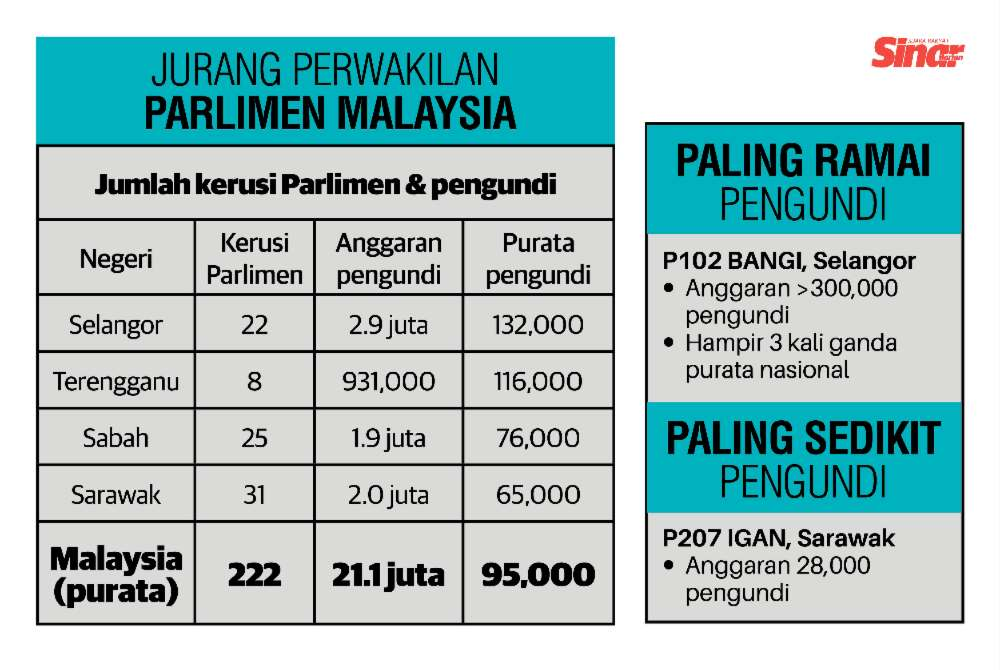
Selangor, the country’s most populous state, has 22 parliamentary seats and 56 DUN seats serving about 2.9 million voters, translating into approximately 132,000 voters per parliamentary seat.
Terengganu, with eight parliamentary seats and 32 DUN seats, has about 931,000 voters, averaging 116,000 voters per parliamentary seat.
The average number of voters per DUN seat is 52,000 in Selangor and 29,000 in Terengganu.
In contrast, Sabah and Sarawak record an average of between 65,000 and 76,000 voters per parliamentary seat, roughly half the average in Selangor.
Sabah has 73 DUN seats with an average of 26,000 voters each, while Sarawak has 82 DUN seats averaging 24,000 voters per constituency.
"Imagine Selangor being overcrowded. There are indeed too many people, but the number of electoral seats is very small," Azmi said.
He added that states such as Penang and Johor remained at acceptable representation levels, while Sabah and Sarawak are clearly overrepresented.
"Although Sabah and Sarawak represent 16 per cent of the total population, both states hold 25 per cent of the total 222 Parliamentary seats," he said.
Despite this, Azmi stressed that Sabah and Sarawak’s position should not be questioned as it is constitutionally guaranteed.
On redelineation, he said the EC’s role is confined to reviewing and redrawing constituency boundaries after the eight-year period, while decisions on increasing parliamentary or DUN seats rest entirely with Parliament and state assemblies.
Regardless of whether additional seats were created, Azmi said the EC must ensure constituency sizes within a state were made more balanced, as permitted by law.
He also stressed the importance of maintaining flexibility when addressing voter disparities between urban and rural constituencies, particularly in geographically large states.
"If a rural constituency is too large but has a small number of voters, we need to provide reasonable justification.
"If forced to equalise the number of voters, the area could become too large and unfair to the elected representative," he said.
Azmi added that Sarawak has been eligible for redelineation since 2023, Sabah is expected to qualify this year and Peninsular Malaysia after March 2026.
Last July, the Sarawak state legislative assembly approved the addition of 17 new seats, raising the total to 99 DUN seats, although the constituencies involved have yet to be announced.
Download Sinar Daily application.Click Here!