Klang Valley gridlock: Structural failures or too many cars?
Experts stress that while festive seasons temporarily exacerbate the situation, the underlying problem remains long-term and systemic.


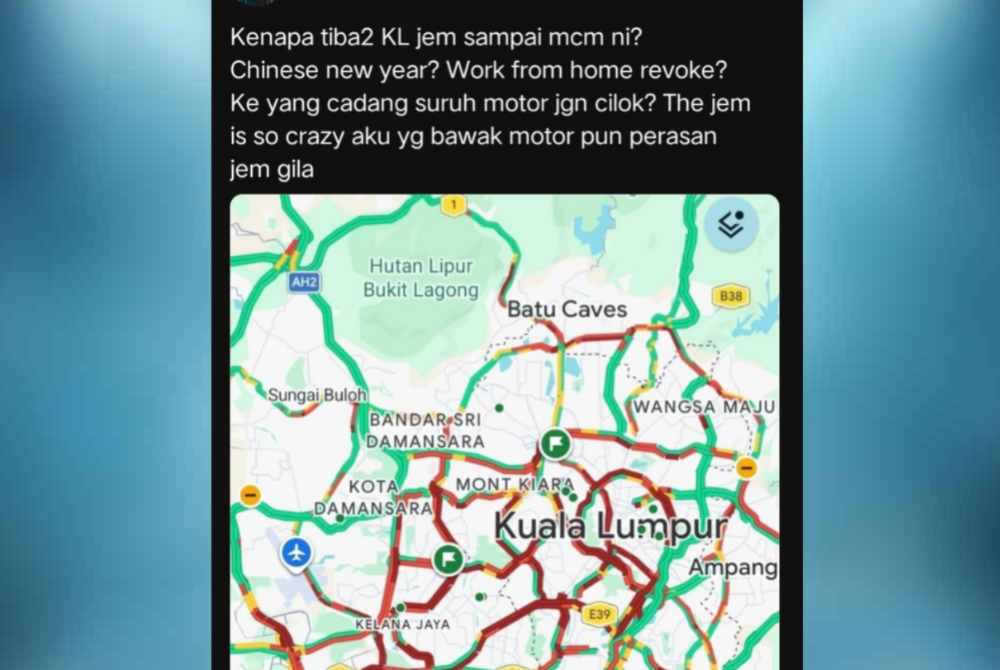
SHAH ALAM – As traffic congestion in the Klang Valley continues to deteriorate, many Malaysians are rejecting the narrative that gridlock is simply the inevitable result of rising car ownership.
Instead, they argue that deeper structural weaknesses, particularly in public transport and urban planning, are at the heart of the problem.
On the social media platform TikTok, a user known as PrincessLaila questioned the common narrative that blames vehicle volume alone.
"Everyone has a car nowadays; that’s the narrative being set. But I still can’t find a single vacant seat at the train stations," she wrote.
Her comments surfaced during an online debate following a report by Sinar Daily yesterday, which stated that Malaysia’s traffic congestion is worsening and is no longer merely a seasonal issue.
Experts have highlighted the rapid rise in vehicle numbers alongside a public transport system that has failed to keep pace with urban expansion.
Motoring expert and Piston.My Managing Editor Keshvinder Singh Dhillon stated that the link between vehicle growth and congestion is undeniable.
“There is definitely a correlation between congestion and the rapid increase of vehicles on our roads. Our infrastructure is designed to accommodate a certain number of vehicles; when that is exceeded, congestion is inevitable,” he told Sinar Daily.
However, he also pointed to broader structural issues, including the heavy concentration of economic activity in Kuala Lumpur and Selangor.
“Unfortunately, our public transport infrastructure is simply not keeping up with the times. Wealth and opportunities are highly centralised in the capital, so people have no choice but to be here for work or study,” he added.
Echoing this sentiment, Threads user Norizuan Rashid observed the shift in household vehicle patterns.
“In the past, it was one house, one car. Now, in one house, everyone has a car,” he said.
Another user, Amsuccess, argued that the issue extends beyond vehicle numbers, claiming that the current infrastructure is no longer adequate.
"The government needs to reform the roads and capacity. Roads need to have an additional 40 per cent more capacity than what is actually being built," the user said.
However, not all netizens believe that road expansion is a panacea.
Several users shifted the focus to the accessibility and efficiency of public transport. User ZKey highlighted design flaws, such as entry and exit points located too close together and poor "last-mile" connectivity to stations.
“Train station accessibility for the masses is poor. Stations are not close enough to housing areas and there is insufficient parking at the hubs,” the user said.
Meanwhile, Azmirovshop urged Malaysians to rethink their dependency on private vehicles: “We should seriously consider public transportation and pressure the government into improving services and public perception.”
Others proposed reducing the need to commute entirely. User Slash suggested tax relief for companies that implement work-from-home (WFH) policies to decentralise urban density.
“Two hours going, two hours coming back from work. That four-hour commute could be used to solve work matters instead,” the user said.
While structural issues dominated the discussion, some believe seasonal factors still play a minor role.
Netizens pointed out that the approaching Chinese New Year (CNY) and the subsequent long weekend could be contributing to the current spike, as people rush for last-minute shopping or travel to their hometowns.
However, experts stress that while festive seasons temporarily exacerbate the situation, the underlying problem remains long-term and systemic.
Download Sinar Daily application.Click Here!