Heavier traffic lately? You’re not imagining it — here’s what’s going on
There is a clear link between the surge in vehicles and worsening congestion.


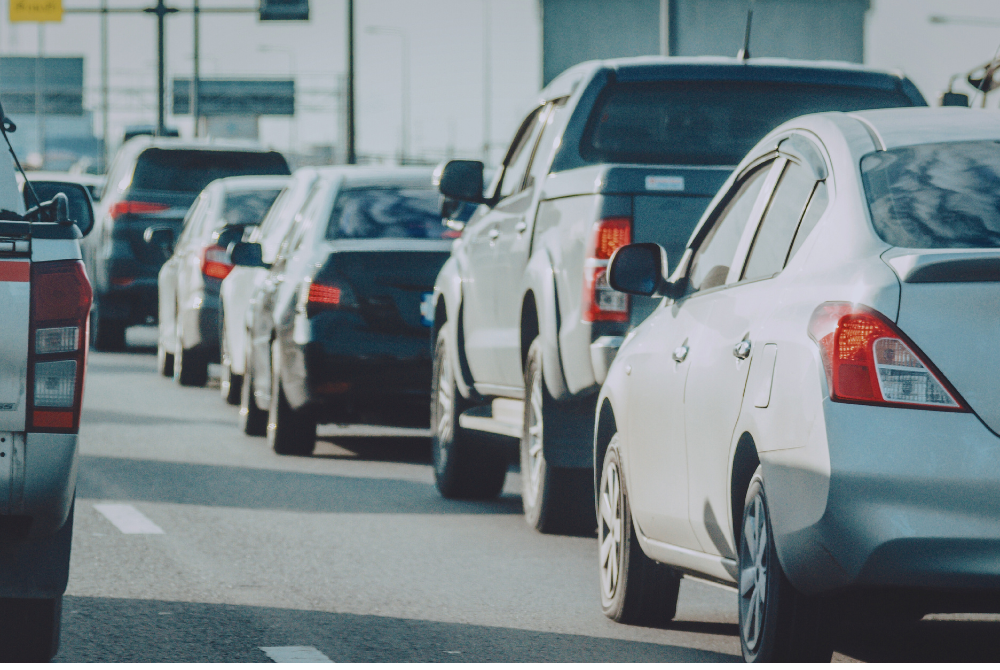
SHAH ALAM - Malaysia’s traffic congestion is worsening and it is not just seasonal. Experts say the main causes are the rapid rise in vehicle numbers and a public transport system that has not kept pace.
Piston.My Managing Editor and motoring expert Keshvinder Singh Dhillon said there is a clear link between the surge in vehicles and worsening congestion.
"There is definitely a correlation between congestion and a rapid increase in vehicles on our roads. Our roads are designed to accommodate a certain number of vehicles. When that number is exceeded, undesired congestion is inevitable," he told Sinar Daily.
Keshvinder also pointed to structural weaknesses in urban planning, including the concentration of jobs and opportunities in major cities, particularly Kuala Lumpur and Selangor.
"Unfortunately, our public transport infrastructure is simply not keeping up with the times, so that is not helping as well. Wealth and opportunities are highly centralised in Kuala Lumpur and Selangor, so people have no choice but to be here if they want jobs or even to study,” he added.
The Chinese New Year (CNY) period has further compounded traffic woes, traditionally bringing a surge in travel as Malaysians return to their hometowns or take short holidays.
“Even though we only officially have Tuesday and Wednesday off (public holidays), many people take the whole week off, leading to a sudden rush to complete pending work, shop and run errands. This naturally results in more vehicles on the road," he said.
Looking ahead, Keshvinder called for long-term solutions beyond temporary fixes such as better train infrastructure, more walkways and improved road designs.
"Most importantly, more opportunities in cities outside of KL. Why not focus on growing cities like Kuantan, Ipoh, Seremban, which are already expanding but need more people to drive growth?," he said.
Meanwhile, Prolintas, the largest highway network operator in the Klang Valley, reported higher-than-usual traffic volumes even during periods that typically see smoother flow.
"Traffic conditions within the Klang Valley are highly interconnected and congestion at major access points or arterial roads may create spillover effects across surrounding highways and interchanges,” it said when contacted
To help ease congestion, Prolintas has implemented several measures. Manual Temporary Lane (MTL) operations have been activated during peak hours at the Ampang and Alam Damai Toll Plazas along the Sungai Besi–Ulu Kelang Expressway (Suke).
Similar measures will be introduced at the Kota Damansara and Denai Alam Toll Plazas on the Damansara-Shah Alam Elevated Expressway (DASH).
MTLs use handheld electronic payment devices to supplement existing systems and improve traffic flow during peak periods.
In addition, manpower has been increased at key toll plazas and the Traffic Management Centre (TMC) continues to monitor conditions, providing real-time updates via electronic signboards and official communication platforms.
Prolintas advised motorists to plan their journeys in advance, factor in extra travel time and use navigation apps for real-time traffic information.
“We advise motorists to plan their journeys in advance, factor in extra travel time and use navigation applications for real-time traffic information. We remain committed to ensuring safe and efficient travel for all road users,” the company said.
Social media users have also shared posts highlighting unusually heavy congestion across major roads in the Klang Valley, particularly within Kuala Lumpur and surrounding urban areas.
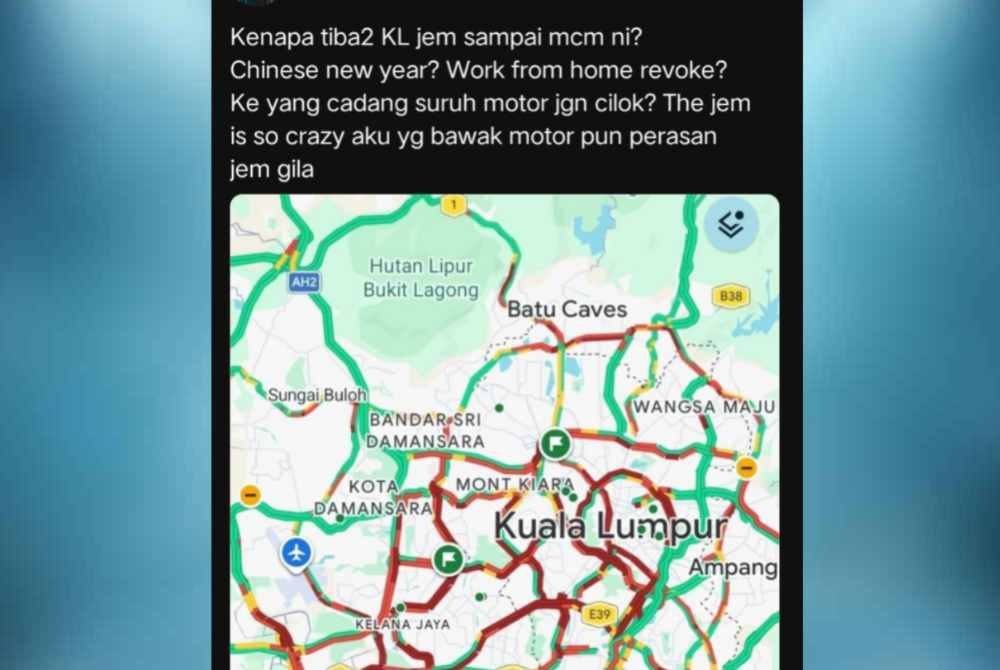
One widely shared post featured a traffic map indicating that the majority of arterial routes in the capital were experiencing severe gridlock, marked prominently in red.
According to the map, heavy congestion was visible along most central Kuala Lumpur routes, including major road networks linking key business districts and residential areas.
Download Sinar Daily application.Click Here!