When Dissent Governs: The Activist's Transition from Protest to Power
Translating protest demands into administrative criteria is not unusual once activism enters government.


IN my twenties, I took a train from Loughborough to Nottingham to attend my first student organised programme that included a series of talks and a staging of Bilik Sulit. Adam Adli Abd Halim was one of the speakers.
Like many Malaysian students studying abroad at the time, I attended because I was idealistic, politically curious and drawn to conversations about the possibility of change back home.
At the time, Adam was associated with a cohort of student activists who had become visible through campus-based organising and street demonstrations addressing issues such as education financing and restrictions on student political participation.
His involvement in campaigns calling for the abolition of student debt under the Perbadanan Tabung Pendidikan Tinggi Nasional (PTPTN) and for the repeal of the Universities and University Colleges Act 1971 placed him among those publicly challenging how universities were governed.
More than a decade later, Adam Adli now serves as Deputy Minister of Higher Education.
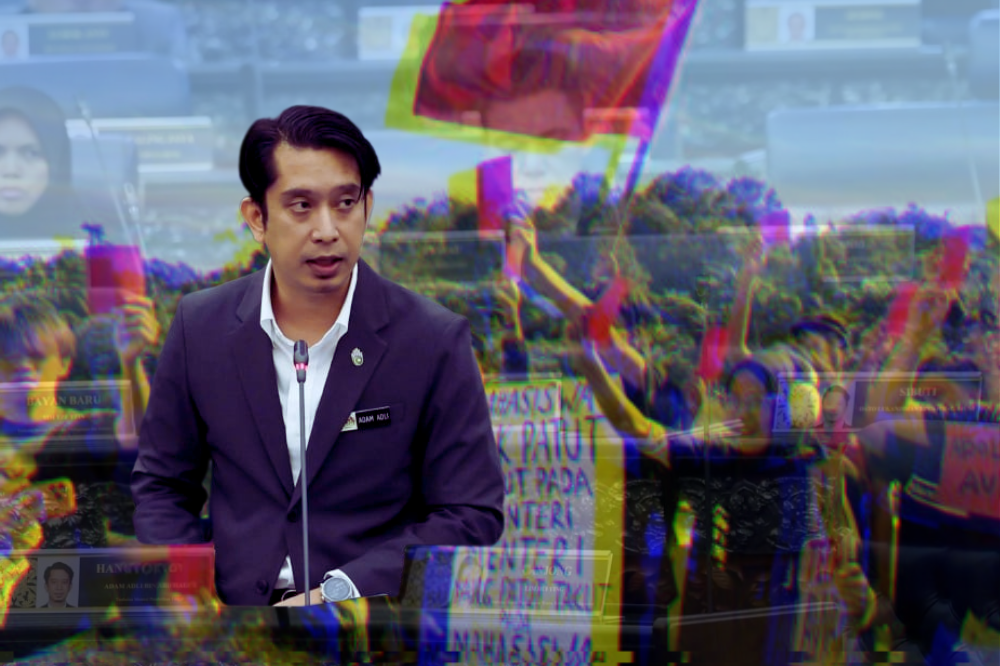
Recently, students gathered outside Parliament in a demonstration organised by the Sekretariat Mansuh AUKU, raising red cards during the submission of a memorandum calling for the repeal of the Universities and University Colleges Act.
The protest was directed at Adam Adli in his capacity as deputy minister. Students jeered him and questioned why a former student activist who had once opposed the legislation was now part of a government that continued to administer it.
Online, footage of the demonstration circulated alongside clips from his earlier years as a student organiser. Commentary frequently returned to his past advocacy on student debt and university autonomy, asking whether positions taken during protest could be reconciled with those adopted within government.
At roughly the same time, Adam Adli has also faced scrutiny over his support for proposals to reintroduce overseas travel restrictions for borrowers under PTPTN who have the financial capacity to repay their loans but remain in default.
To many of those who once stood alongside him, this looks like a reversal. To some of his political opponents, it presents an opportunity to suggest that his earlier activism was easier to demand than to implement.
In 2012, Adam publicly called for extensive reforms to the student loan system, arguing that access to higher education should not be contingent upon long term debt obligations and criticising enforcement measures that restricted borrowers from travelling abroad. In 2019, he again expressed opposition to suggestions that travel bans, which had been lifted in 2018, should be reinstated.
More recently, however, he has indicated that any reintroduction of travel restrictions would be targeted at higher income defaulters who are assessed to have the means to repay.
Translating protest demands into administrative criteria is not unusual once activism enters government.
Debates surrounding PTPTN were never limited to repayment itself. They were also concerned with how compliance was secured. Travel restrictions do not restructure a loan or expand repayment assistance. They restrict movement in order to compel repayment.
This is precisely where the earlier disagreement lay.
PTPTN is structured as a revolving fund in which loans that are repaid finance access for future cohorts of students. Without repayment, the system struggles to sustain itself, and without sustainability, access to higher education contracts.
Abolishing PTPTN debt would reduce the burden on current borrowers. It would also require identifying who finances access for the next cohort.
Such questions tend not to arise during protest.
Similarly, the Universities and University Colleges Act 1971 continues to provide the statutory framework through which student political participation in Malaysian universities is regulated. Calls for its abolition reflect longstanding discomfort with the limits it places on association and representation.
Yet the legislation has persisted across successive administrations.
Universities are public institutions, and questions of accountability and liability do not disappear simply because the legislation that governs them is unpopular.
Entering government does not resolve the conflict that produced the movement in the first place.
The red cards outside Parliament make this clear.
The disagreement between student autonomy and state regulation does not disappear when activists gain office. It follows them into it.
Outside the state, dissent is organised around critique. Its task is to identify injustice, mobilise support, and insist that alternative arrangements are possible. Within the state, however, the same dissent must now contend with policy continuity, fiscal constraint, and institutional responsibility.
The activist does not disappear upon assuming office. The activist becomes responsible for implementation, and implementation rarely affords the same clarity as protest.
This is why the recent protest matters.
It indicates that the underlying disagreement between student movements and the regulatory frameworks governing higher education has not been resolved by the entry of former activists into government.
The transition from protest to power does not automatically translate into policy transformation.
In the end, the state does not always defeat dissent by suppressing it.
Sometimes, dissent finds its way into government.
And once dissent becomes responsible for sustaining the system it once resisted, who remains outside to demand that the system change?
Dr Siti Nurnadilla Mohamad Jamil is a linguist and discourse analyst whose research focuses on language, ideology, and the legitimisation of violence in media and political discourse. She is currently a Visiting Researcher at Lancaster University and an Assistant Professor of Linguistics at the International Islamic University Malaysia. The views expressed in this article are those of the authors and do not necessarily reflect the editorial position of Sinar Daily.
Download Sinar Daily application.Click Here!


